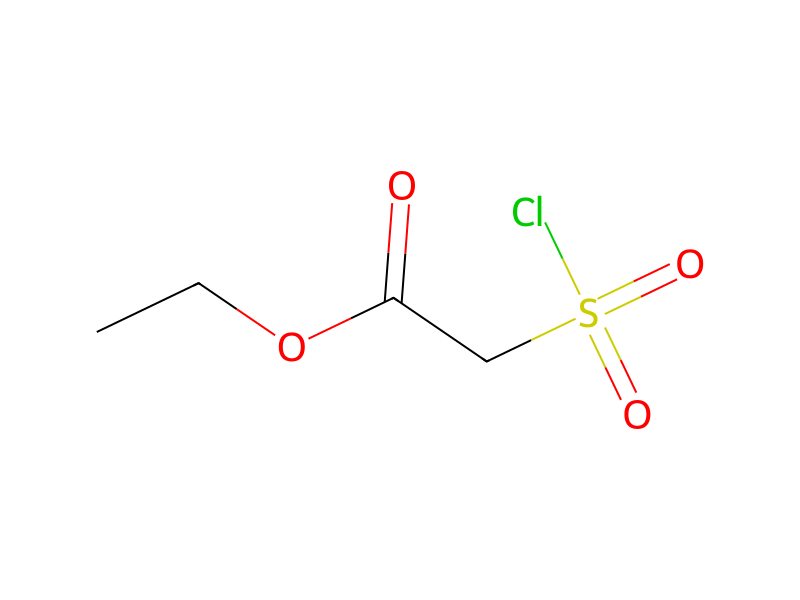
Phosphorus oxychloride → Ethyl (chlorosulfonyl)acetate
Reaction equation

[S:1]([CH2:5][C:6]([O:8][CH2:9][CH3:10])=[O:7])(O)(=[O:3])=[O:2].O=P(Cl)(Cl)[Cl:13]>>[Cl:13][S:1]([CH2:5][C:6]([O:8][CH2:9][CH3:10])=[O:7])(=[O:3])=[O:2]Participants


Procedure
1H NMR (CDCl3):δ1.35 (t, 3H), 4.1 (s, 2H), 4.25 (q, 2H). Amixture of ethyl sulfoacetate (16.82 g, 100 mM) and POCl3 (30.67 g, 200 mM) was heated at 125° C. for 5 hours. The mixture was cooled and filtered, and excess POCl3 was removed to give ethyl chlorosulfonylacetate. The ethyl chlorosulfonylacetate (8.18 g, 43.83 mM) was added dropwise with stirring to a solution of 2,6-diisopropylaniline (15.54 g, 87.66 mM) in 50 mL CH2Cl2 maintained at 0° C. The mixture was stirred at room temperature for an additional 18 hours. The solvent was removed and the residue was redissolved in 100 mL ethyl acetate and washed with 1N HCl and brine. The ethyl acetate was evaporatedand the pure compound was isolated by chromatography over silica gel (EtOAc/hexane, 1:4 as eluant) as a white powder identified as ethyl (2,6-diisopropylphenylsulfamoyl)acetate, 7.0 g (≈50%), mp 74°-77° C.
Workup
- temperatureThe mixture was cooled
- filtrationfiltered
- customexcess POCl3 was removed
Sources & evidence
- ORD record
- ord-ef6da34a09e74f8c8221b2c00982a6b0
- Source dataset
- uspto-grants-1996_02
- Patent number
- US05491170
Reaction notes
Loading…