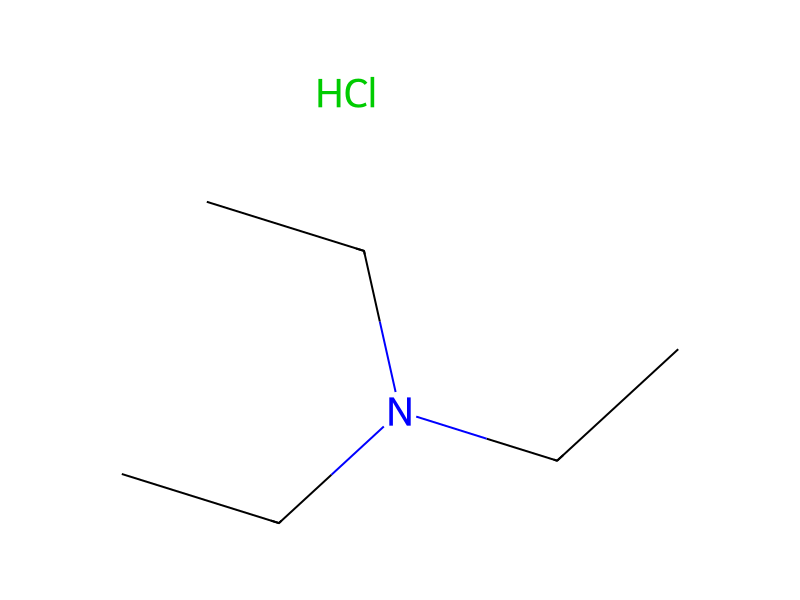
Triethylamine hydrochloride → [(6-Chlorohexyl)oxy](1,1-dimethylethyl)dimethylsilane
Reaction equation

[Si:1](Cl)([C:4]([CH3:7])([CH3:6])[CH3:5])([CH3:3])[CH3:2].[SiH3]Cl.[Cl:11][CH2:12][CH2:13][CH2:14][CH2:15][CH2:16][CH2:17][OH:18].Cl.C(N(CC)CC)C>C(N(CC)CC)C.C1CCCCC1>[Si:1]([O:18][CH2:17][CH2:16][CH2:15][CH2:14][CH2:13][CH2:12][Cl:11])([C:4]([CH3:7])([CH3:6])[CH3:5])([CH3:3])[CH3:2]Participants
Reactant 4


Product 1

Reagents, catalysts & solvents 2


Procedure
A 250 ml, three-necked flask was fitted with a large magnetic, egg-shaped stir bar, a thermocouple, a small, pressure-equalizing addition funnel, a reflux condenser, and an argon inlet. This apparatus was dried in an oven overnight at 125° C., assembled hot, and allowed to cool to room temperature in a stream of argon. The flask was charged with 16.20 grams (0.108 mole, 1.00 equivalents) of t-butyldimethylsilyl chloride, and 100 grams of cyclohexane. The silyl chloride rapidly dissolved, endothermically. 6-Chloro-1-hexanol, 15.06 grams (0.108 mole, 1.00 equivalent) was then added dropwise in five minutes. Triethylamine, 10.93 grams (0.108 mole, 1.00 equivalent) was then added dropwise to the reaction mixture. An exotherm was noted, and fumes of triethylamine hydrochloride were observed. A fine, white precipitate rapidly developed. The reaction mixture was stirred at room temperature, and monitored by GC analysis. An aliquot of the clear supernatant was injected into the GC. After one and a half hours, both starting materials were still present, and the conversion to the desired product was only 27.8%. The reaction mixture was stirred overnight at room temperature, under a blanket of argon. The sample after 21 hours indicated only a 53.3% conversion to the desired product. After 161.5 hours stirring, the conversion was still only 88.0%.
Workup
- customA 250 ml, three-necked flask was fitted with a large magnetic, egg-shaped stir bar
- additiona thermocouple, a small, pressure-equalizing addition funnel, a reflux condenser, and an argon inlet
- customThis apparatus was dried in an oven overnight at 125° C.
- waitAfter one and a half hours
Sources & evidence
- ORD record
- ord-227d9281b989428bad3ebcf03ca7b5b5
- Source dataset
- uspto-grants-1996_02
- Patent number
- US05493044
Reaction notes
Loading…