Triethylamine → HCID 45118489, compound
Reaction equation

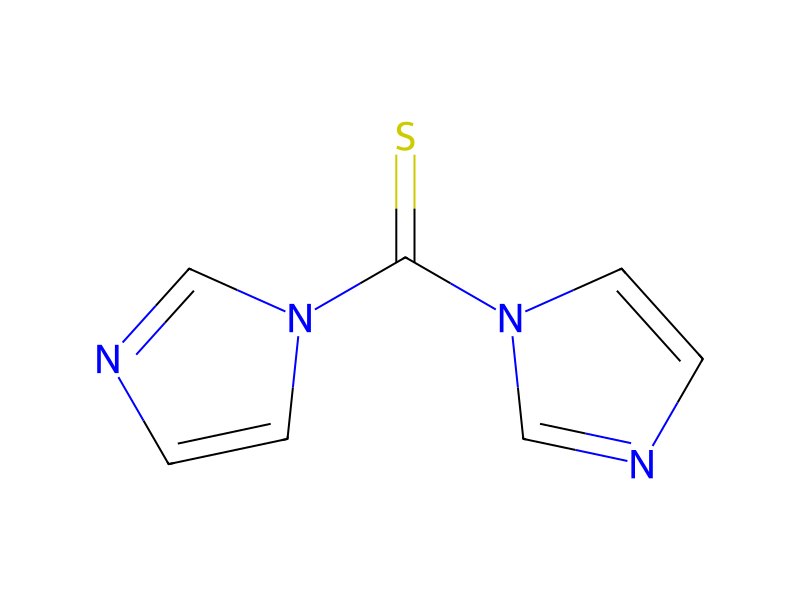
Cl.[F:2][C:3]1([F:9])[CH2:8][CH2:7][NH:6][CH2:5][CH2:4]1.C(N(CC)CC)C.C1N=C[N:19]([C:22](N2C=NC=C2)=[S:23])C=1>C1COCC1>[F:2][C:3]1([F:9])[CH2:8][CH2:7][N:6]([C:22]([NH2:19])=[S:23])[CH2:5][CH2:4]1Participants
5
Reactant 3


Product 1

Reagents, catalysts & solvents 1

Procedure
Commercially available 4,4-difluoropiperidine hydrochloride (883 mg, 5.60 mmol) and triethylamine (0.85 mL, 6.10 mmol) were added to a solution of 1,1-thiocarbonyldiimidazole (1.05 g, 5.89 mmol) in THF (20 mL) under ice-cooling, followed by stirring at room temperature for 3 hr in an argon atmosphere. The reaction solution was concentrated. Concentrated aqueous ammonia (30 mL) was added to the residue, followed by stirring overnight at room temperature. The precipitated crystals were collected by filtration, washed with water, and dried to obtain 4,4-difluoropiperidinothiocarboxamide (850 mg, 4.72 mmol) as a light yellow powder.
Workup
- temperaturecooling
- concentrationThe reaction solution was concentrated
- additionConcentrated aqueous ammonia (30 mL) was added to the residue
- stirringby stirring overnight at room temperature
- filtrationThe precipitated crystals were collected by filtration
- washwashed with water
- customdried
Sources & evidence
- ORD record
- ord-52d07266d4424bec879d2720bbc81298
- Source dataset
- uspto-grants-2014_08
- Patent number
- US08796320B2
Reaction notes
Loading…