Benzaldehyde → Benzothiazol-2-yl-phenyl-methanol
Reaction equation

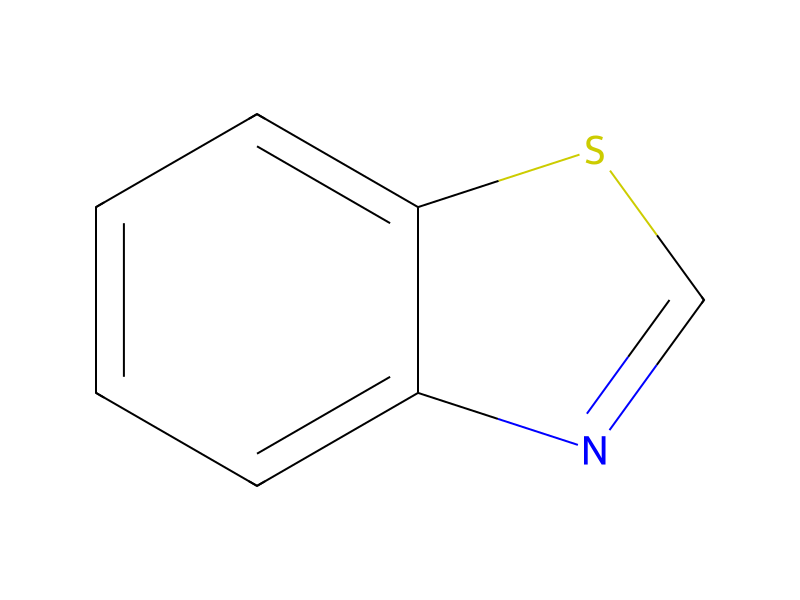
[S:1]1[C:5]2[CH:6]=[CH:7][CH:8]=[CH:9][C:4]=2[N:3]=[CH:2]1.C([Li])CCC.[CH:15](=[O:22])[C:16]1[CH:21]=[CH:20][CH:19]=[CH:18][CH:17]=1>O1CCCC1>[S:1]1[C:5]2[CH:6]=[CH:7][CH:8]=[CH:9][C:4]=2[N:3]=[C:2]1[CH:15]([C:16]1[CH:21]=[CH:20][CH:19]=[CH:18][CH:17]=1)[OH:22]Participants
5
Reactant 3


Product 1

Reagents, catalysts & solvents 1

Conditions
- Temperature
- -20 °C
Procedure
A solution of benzothiazole (1.35 g) in tetrahydrofurane (10 mL) in a dried round bottom baloon is cooled at −70° C. A solution of butyl lithium (4.1 mL) is added and the mixture stirred for 15 minutes. Benzaldehyde (1.03 mL) diluted with tetrahydrofurane (10 mL) is then added. The mixture is stirred at −70° C. for 1 h, allowed to warm to −20° C. and quenched with saturated aqueous ammonium chloride solution. The mixture is extracted with ethyl acetate. Organic extracts are pooled, dried over magnesium sulfate and concentrated under reduced pressure. Trituration of the residue with diisopropyl oxyde affords benzothiazol-2-ylphenylmethanol.
Workup
- additionis then added
- stirringThe mixture is stirred at −70° C. for 1 h
- customquenched with saturated aqueous ammonium chloride solution
- extractionThe mixture is extracted with ethyl acetate
- dry with materialdried over magnesium sulfate
- concentrationconcentrated under reduced pressure
Sources & evidence
- ORD record
- ord-19108a02a6d44e2ca850634076d4fedc
- Source dataset
- uspto-grants-2014_08
- Patent number
- US08802664B2
Reaction notes
Loading…