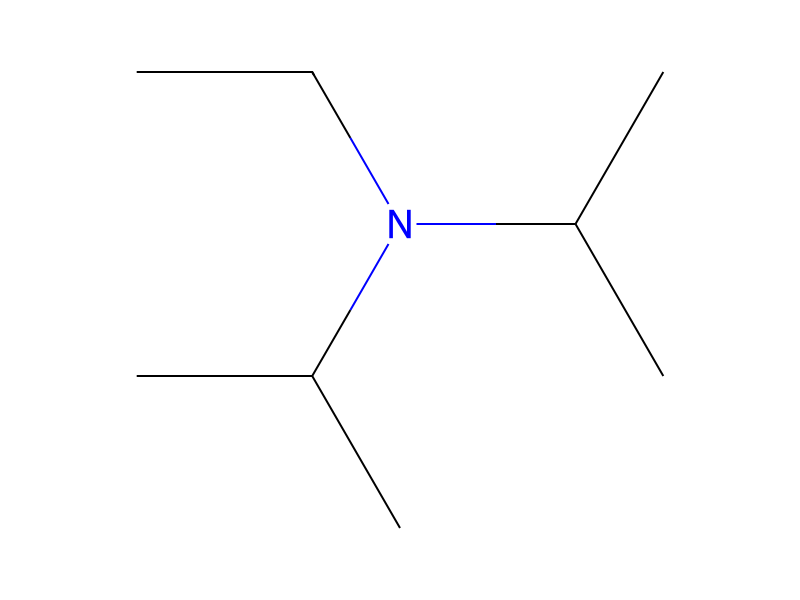
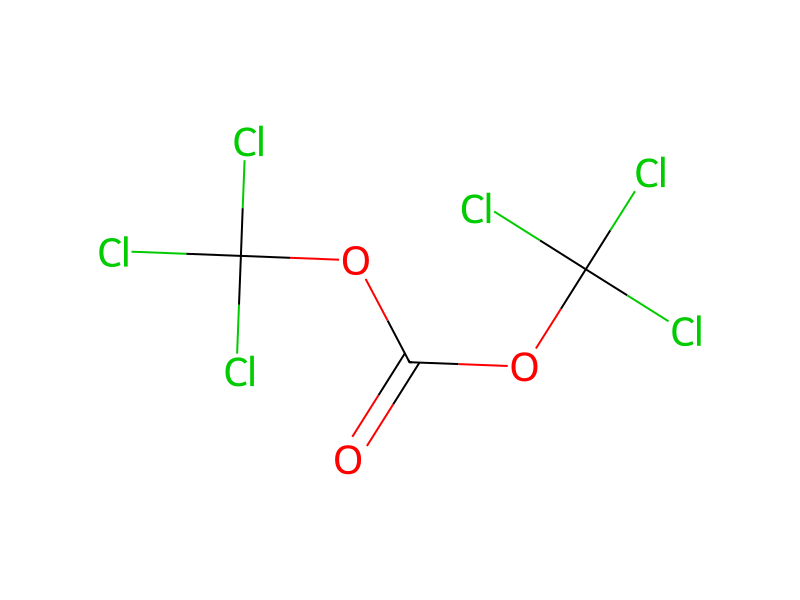
Diisopropylethylamine → N-(4-bromo-2-chloro-6-fluorophenyl)-2-{[(3S)-1-(cyclopropylcarbonyl)-3-pyrrolidinyl]acetyl}hydrazinecarboxamide
Reaction equation

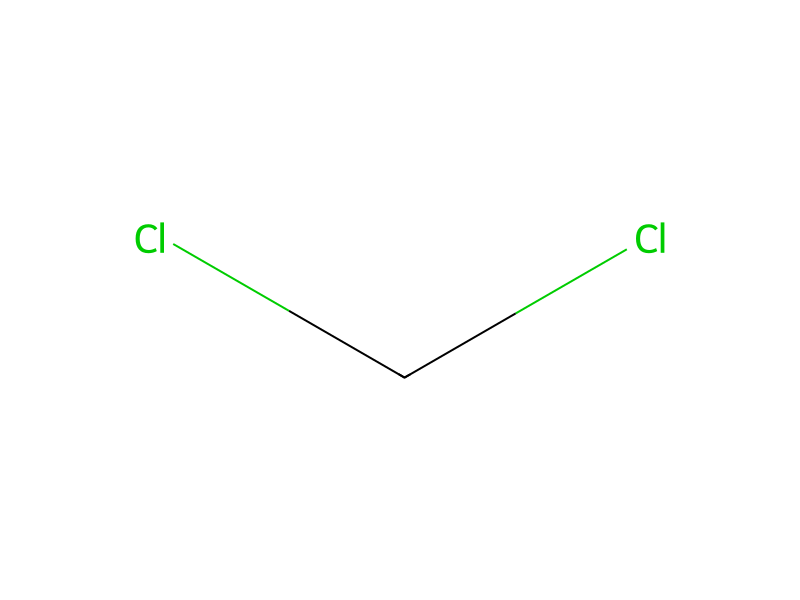
Cl[C:2](Cl)([O:4]C(=O)OC(Cl)(Cl)Cl)Cl.[Br:13][C:14]1[CH:20]=[C:19]([F:21])[C:17]([NH2:18])=[C:16]([Cl:22])[CH:15]=1.CCN(C(C)C)C(C)C.[CH:32]1([C:35]([N:37]2[CH2:41][CH2:40][C@@H:39]([CH2:42][C:43]([NH:45][NH2:46])=[O:44])[CH2:38]2)=[O:36])[CH2:34][CH2:33]1>ClCCl>[Br:13][C:14]1[CH:20]=[C:19]([F:21])[C:17]([NH:18][C:2]([NH:46][NH:45][C:43](=[O:44])[CH2:42][C@@H:39]2[CH2:40][CH2:41][N:37]([C:35]([CH:32]3[CH2:34][CH2:33]3)=[O:36])[CH2:38]2)=[O:4])=[C:16]([Cl:22])[CH:15]=1Participants
Reactant 4


Product 1

Reagents, catalysts & solvents 1
Conditions
- Temperature
- -78 °C
Procedure
To a round bottom flask was added triphosgene (2.63 mmol) and dichloromethane (20 mL) under nitrogen, and the solution was cooled to −78° C. In a separate vial, 4-bromo-2-chloro-6-fluoroaniline (6.46 mmol) was dissolved in dichloromethane (20 mL) and Hunig's base (17.2 mmol) was added. This solution was slowly added to the cooled solution and then the reaction was allowed to warm to room temperature. After 5 h, analysis by LCMS indicated desired intermediate formation. The reaction was cooled again to −78° C. and 2-[(3S)-1-(cyclopropylcarbonyl)-3-pyrrolidinyl]acetohydrazide (4.31 mmol) in dichloromethane (5 mL) was added slowly. The reaction was allowed to warm to room temperature and stirred for 70 h. Analysis by LCMS indicated desired product formation. The mixture was concentrated and suspended in water (130 mL). Potassium carbonate (9.85 mmol) was added and the mixture was heated at reflux (110° C.) for 18 h. Analysis by LCMS indicated a small amount of desired product (and other major by-products). The reaction was cooled to room temperature and the pH was adjusted to ˜6 with 1N and 6N aq HCl, and then poured into a separatory funnel containing ethyl acetate. The aqueous layer was extracted with ethyl acetate (3×) and the combined organic layers were dried over Na2SO4, filtered, and concentrated to an oil. The residue was purified by reverse phase HPLC (10-90% acetonitrile/water+0.1% TFA). The desired fractions were collected and added to a separatory funnel containing ethyl acetate. The aqueous phase was adjusted to pH˜6 with 1N aq HCl. The aqueous phase was extracted with ethyl acetate (3×), and the combined organics were washed with brine, dried over Na2SO4, and concentrated to afford the title product as an off-white solid (12 mg, 1% over two steps). MS(ES)+ m/e 443.0, 445.0 [M+H]+.
Workup
- additionThis solution was slowly added to the cooled solution
- temperatureto warm to room temperature
- temperatureThe reaction was cooled again to −78° C.
- temperatureto warm to room temperature
Sources & evidence
- ORD record
- ord-1c17a2b0893a44428cbe8f0dbed8f24b
- Source dataset
- uspto-grants-2014_08
- Patent number
- US08802864B2
Reaction notes
Loading…