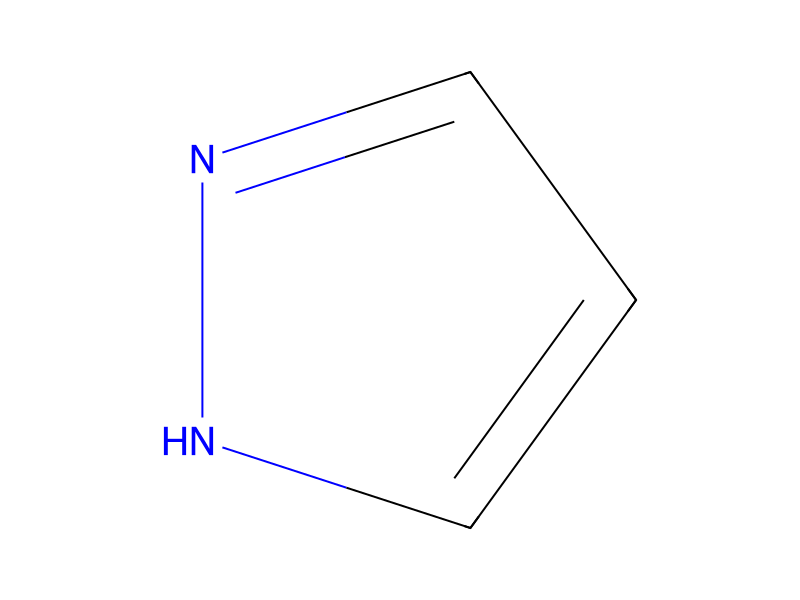
Pyrazole → HCID 61631227, compound
Reaction equation

[NH:1]1C=CC=N1.ClC1C(C(NC2C=CC=CC=2[C:22]2[CH:27]=[C:26]([F:28])[C:25]([N:29]3[CH:33]=[CH:32][C:31]([C:34]([F:37])([F:36])[F:35])=[N:30]3)=[C:24]([F:38])[CH:23]=2)=O)=CC=CN=1.O.O.[Sn](Cl)Cl>C(O)C>[F:38][C:24]1[CH:23]=[C:22]([NH2:1])[CH:27]=[C:26]([F:28])[C:25]=1[N:29]1[CH:33]=[CH:32][C:31]([C:34]([F:37])([F:36])[F:35])=[N:30]1Participants
5
Reactant 3


Product 1

Reagents, catalysts & solvents 1

Procedure
A mixture of 1-(2,6-difluoro-4-nitrophenyl)-3-trifluoromethyl)-1H-pyrazole (i.e. the product of Step A; 2.39 g, 8.15 mmol) and tin(II) chloride dihydrate (9.33 g, 41.3 mmol) in ethanol (173 mL) was refluxed for 2 h. The reaction mixture was concentrated under reduced pressure, and the residue was dissolved in ethyl acetate and washed successively with 1 N aqueous sodium hydroxide, and then water. The organic layer was dried (MgSO4), filtered and concentrated under reduced pressure. The residue was purified by medium pressure liquid chromatography on silica gel eluted with 0 to 100% ethyl acetate in hexanes to provide the title compound (2.00 g).
Workup
- concentrationThe reaction mixture was concentrated under reduced pressure
- dissolutionthe residue was dissolved in ethyl acetate
- washwashed successively with 1 N aqueous sodium hydroxide
- dry with materialThe organic layer was dried (MgSO4)
- filtrationfiltered
- concentrationconcentrated under reduced pressure
- customThe residue was purified by medium pressure liquid chromatography on silica gel
- washeluted with 0 to 100% ethyl acetate in hexanes
Sources & evidence
- ORD record
- ord-9501c6737c3041f5864d7c133f8f5aa0
- Source dataset
- uspto-grants-2014_08
- Patent number
- US08815772B2
Reaction notes
Loading…