Dichloromethane → HCID 23149635, compound
Reaction equation

Cl.[C:2](Cl)(=[O:9])[C:3]1[CH:8]=[CH:7][N:6]=[CH:5][CH:4]=1.C(N(CC)CC)C.ClCCl.[Br:21][C:22]1[CH:28]=[CH:27][C:26]([C:29]([F:32])([F:31])[F:30])=[CH:25][C:23]=1[NH2:24]>O>[Br:21][C:22]1[CH:28]=[CH:27][C:26]([C:29]([F:31])([F:32])[F:30])=[CH:25][C:23]=1[NH:24][C:2](=[O:9])[C:3]1[CH:8]=[CH:7][N:6]=[CH:5][CH:4]=1Participants





Procedure
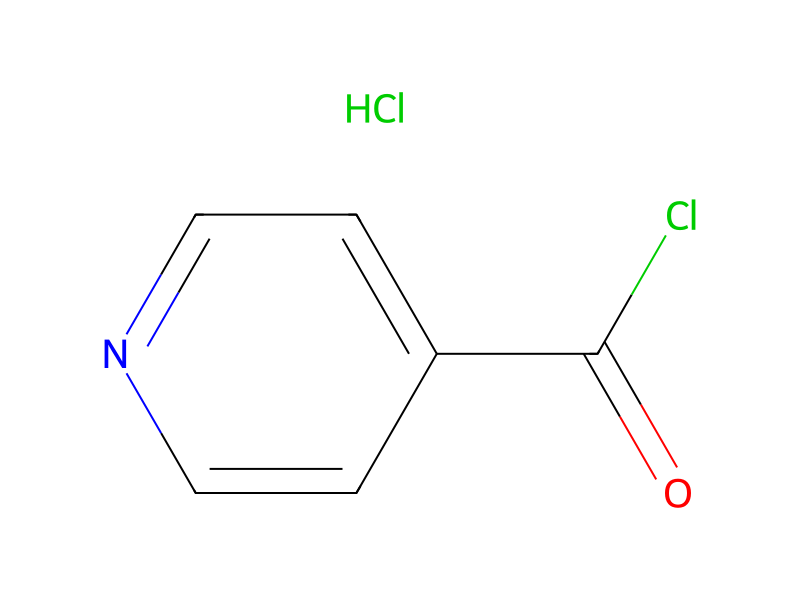
Isonicotinoyl chloride hydrochloride (427 mg, 2.39 mmol, commercially available product) and triethylamine (410 μl, 2.94 mmol) were sequentially added at 0° C. to a dichloromethane (5 ml) solution of 2-bromo-5-(trifluoromethyl)aniline (480 mg, 2.00 mmol; commercially available product). The resulting mixture was warmed to room temperature and stirred for 24 hours. Water was added to the mixture, and the resulting mixture was extracted three times with ethyl acetate. The obtained organic layer was washed with a saturated sodium chloride solution, dried over anhydrous sodium sulfate, filtered, and concentrated under reduced pressure. The residue was purified by recrystallization (ethyl acetate). Thus, N-[2-bromo-5-(trifluoromethyl)phenyl]isonicotinamide (GIF-0612) (308 mg, 44.8%) was yielded as a colorless solid.
Workup
- extractionthe resulting mixture was extracted three times with ethyl acetate
- washThe obtained organic layer was washed with a saturated sodium chloride solution
- dry with materialdried over anhydrous sodium sulfate
- filtrationfiltered
- concentrationconcentrated under reduced pressure
- customThe residue was purified by recrystallization (ethyl acetate)
Sources & evidence
- ORD record
- ord-4626a1099696477ab7473634407a26ad
- Source dataset
- uspto-grants-2014_08
- Patent number
- US08816089B2
Reaction notes
Loading…