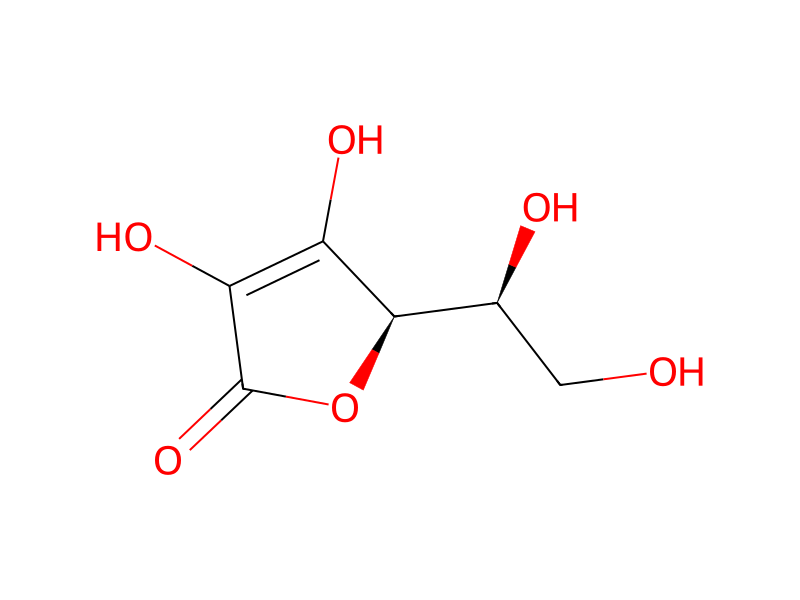
Hydrochloric Acid → L-Ascorbic Acid
Reaction equation

Cl.[Na].[CH2:3]([OH:15])[C@H:4]([OH:14])[C@@H:5](O)[C@H:6]([OH:12])[C:7]([C:9]([O-:11])=[O:10])=[O:8]>>[O:10]=[C:9]1[O:11][C@H:5]([C@H:4]([CH2:3][OH:15])[OH:14])[C:6]([OH:12])=[C:7]1[OH:8]Participants


Procedure
L-ascorbic acid is prepared from sodium 2-keto-L-gulonate by introducing gaseous hydrogen chloride in a molar ratio of about 1.5-2.0 to the sodium-2-keto-L-gulonate into a mixture composed of the sodium 2-keto-L-gulonate, ethanol and acetone at a ratio of 1:0.25-1.00:0.5-2.5 by weight at a temperature of about 25°-75° C. until precipitation of sodium chloride ends, removing the precipitated sodium chloride before L-ascorbic acid begins to crystalize out, maintaining the filtrate or supernatant at a temperature of about 25°-75° C. for a period of 5-100 hours and cooling it to yield crystals of L-ascorbic acid as a final product. A solvent inert to the L-ascorbic acid and 2-keto-L-gulonate may be added to the filtrate or supernatant with a favorable result in obtaining purer intended product.
Workup
- customcomposed of the sodium 2-keto-L-gulonate, ethanol and acetone at a ratio of 1:0.25-1.00:0.5-2.5 by weight at a temperature of about 25°-75° C. until precipitation of sodium chloride
- customremoving the precipitated sodium chloride before L-ascorbic acid
- customto crystalize out
- temperaturemaintaining the filtrate or supernatant at a temperature of about 25°-75° C. for a period of 5-100 hours
- temperaturecooling it
Sources & evidence
- ORD record
- ord-de0b71ae10d044409b6261710b7fe69a
- Source dataset
- uspto-grants-1985_01
- Patent number
- US04491668
Reaction notes
Loading…