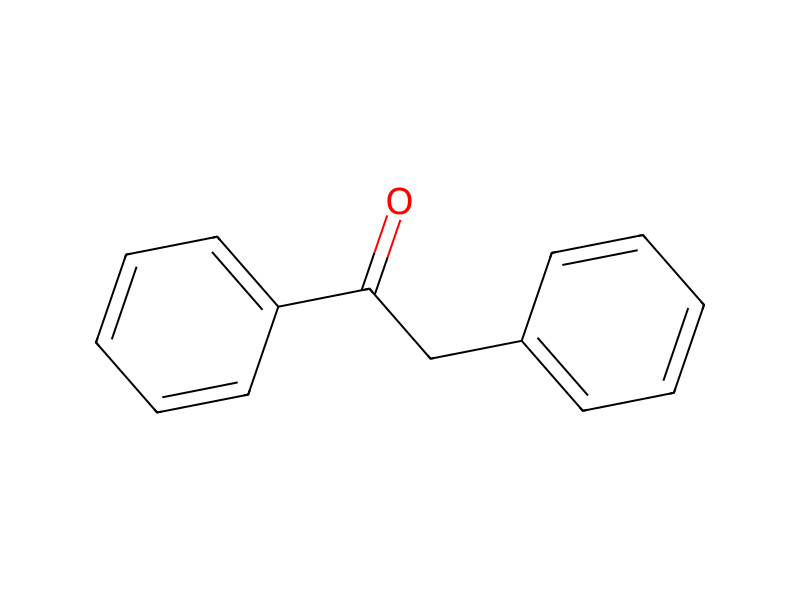
2-Phenylacetophenone → HCID 57170110, compound
Reaction equation

[C:1]1([C:7]([CH2:9][C:10]2[CH:15]=[CH:14][CH:13]=[CH:12][CH:11]=2)=[O:8])[CH:6]=[CH:5][CH:4]=[CH:3][CH:2]=1.[CH3:16][N:17]([CH3:22])[N:18]=[CH:19][CH:20]=O.[O-]CC.[Na+].[Na]>C(O)C.C1(C)C=CC=CC=1.C(OCC)(=O)C>[CH3:16][N:17]([CH3:22])[N:18]=[CH:19][CH:20]=[C:9]([C:10]1[CH:11]=[CH:12][CH:13]=[CH:14][CH:15]=1)[C:7]([C:1]1[CH:2]=[CH:3][CH:4]=[CH:5][CH:6]=1)=[O:8]Participants






Procedure
To a mixture of 19.6 g (0.1 mole) desoxybenzoin and 10 g (0.1 mole) of glyoxal mono(dimethylhydrazone) in 100 ml ethanol was added dropwise a solution of sodium ethoxide prepared by dissolving 2.3 g (0.1 mole) sodium metal in 100 ml ethanol. The mixture was heated at reflux for one-half hour. TLC (90/10, toluene/ethyl acetate) showed a small amount of starting desoxybenzoin, so 2.0 g (0.02 mole) of additional glyoxal mono(dimethylhydrazone) was added. Heating was continued another two hours. TLC at this time showed no starting material, and two clean close yellow product spots (isomers). The mixture was poured into 1 l ice water then extracted with methylene chloride. The organic extracts were dried and concentrated on a rotary evaporator to give 28.7 g (100%) of yellow oil. The NMR showed the presence of two major N(CH3)2 containing materials (product isomers). The crude oil crystallized from isopropanol to give one pure isomer of product, 13.4 g (48%), pale yellow crystals, m.p. 131° -2°.
Workup
- customprepared
- temperatureThe mixture was heated
- temperatureat reflux for one-half hour
- additionwas added
- temperatureHeating
- extractionthen extracted with methylene chloride
- customThe organic extracts were dried
- concentrationconcentrated on a rotary evaporator
Sources & evidence
- ORD record
- ord-82cb9058ab954d0e82134f3a612b3467
- Source dataset
- uspto-grants-1985_01
- Patent number
- US04495196
Reaction notes
Loading…