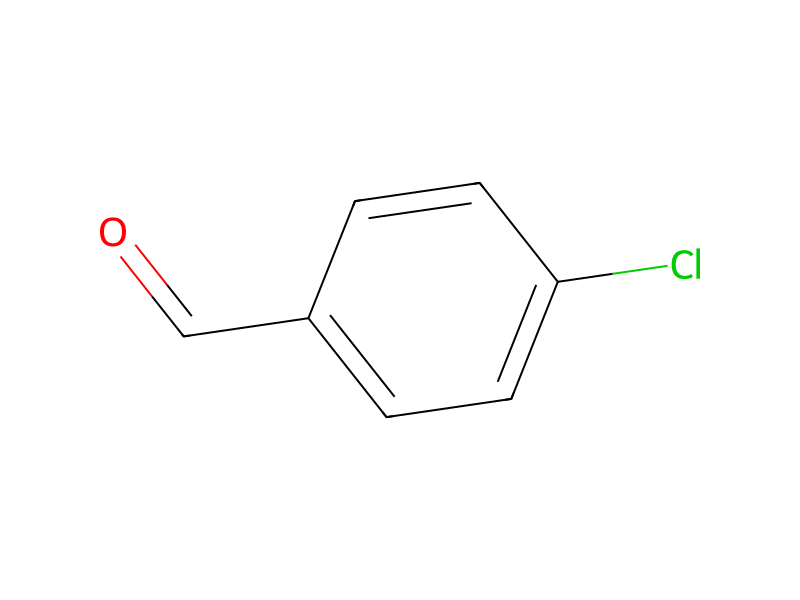
4-Chlorobenzaldehyde → 4-(Pyridin-2-ylsulfanyl)benzaldehyde
Reaction equation

[N:1]1[CH:6]=[CH:5][CH:4]=[CH:3][C:2]=1[SH:7].Cl[C:9]1[CH:16]=[CH:15][C:12]([CH:13]=[O:14])=[CH:11][CH:10]=1.C(=O)([O-])[O-].[K+].[K+]>CN(C)P(N(C)C)(N(C)C)=O>[N:1]1[CH:6]=[CH:5][CH:4]=[CH:3][C:2]=1[S:7][C:9]1[CH:16]=[CH:15][C:12]([CH:13]=[O:14])=[CH:11][CH:10]=1Participants
5
Reactant 3


Product 1

Reagents, catalysts & solvents 1

Conditions
- Temperature
- 140 °C
Procedure
A mixture of 18.4 g of 2-pyridinethiol, 23.2 g of 4-chlorobenzaldehyde, 40 g of potassium carbonate and 100 ml of hexamethylphosphoramide was heated at a temperature of 140° C. for 4 hours. After cooling, the mixture was filtered and the filtrate was concentrated. The resulting oily substance was dissolved in diethyl ether and the solution was washed successively with an aqueous solution of sodium hydroxide and water, and dried over magnesium sulfate. The solvent was distilled off and the resulting oily substance was distilled under reduced pressure to obtain 15 g (42% yield) of 4-(2-pyridylthio)benzaldehyde as a colorless oil having a boiling point of 136° C./2 mmHg.
Workup
- temperatureAfter cooling
- filtrationthe mixture was filtered
- concentrationthe filtrate was concentrated
- dissolutionThe resulting oily substance was dissolved in diethyl ether
- washthe solution was washed successively with an aqueous solution of sodium hydroxide and water
- dry with materialdried over magnesium sulfate
- distillationThe solvent was distilled off
- distillationthe resulting oily substance was distilled under reduced pressure
Sources & evidence
- ORD record
- ord-764d786d4b5c475098dedf563366506b
- Source dataset
- uspto-grants-1985_01
- Patent number
- US04496735
Reaction notes
Loading…