Benzophenone → HCID 22630525, compound
Reaction equation

[H][H].[C:3]1([C:9](=[C:12]([C:19]2[CH:24]=[CH:23][CH:22]=[CH:21][CH:20]=2)[C:13]2[CH:18]=[CH:17][CH:16]=[CH:15][CH:14]=2)[C:10]#[N:11])[CH:8]=[CH:7][CH:6]=[CH:5][CH:4]=1.[Br:25]C1C=CC(C#N)=CC=1.C(C1C=CC=CC=1)(=O)C1C=CC=CC=1>>[Br:25][C:6]1[CH:5]=[CH:4][C:3]([C:9](=[C:12]([C:13]2[CH:14]=[CH:15][CH:16]=[CH:17][CH:18]=2)[C:19]2[CH:20]=[CH:21][CH:22]=[CH:23][CH:24]=2)[C:10]#[N:11])=[CH:8][CH:7]=1Participants




Procedure
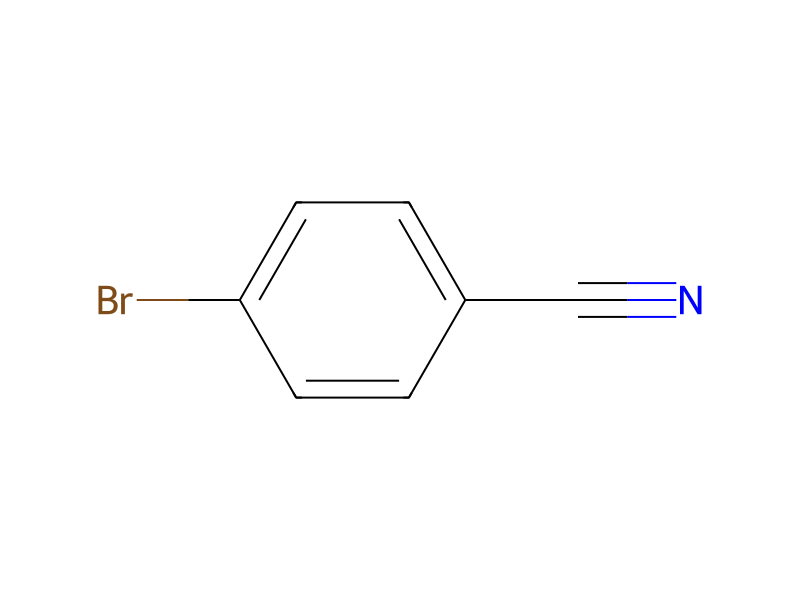
A related material was prepared in which the vinylic hydrogen of C(DPVBi)4 is substituted with a cyano group. The stabilized LUMO of the cyano-substituted triphenylethene fragment (2,3,3-triphenylacrylonitrile) is expected to enhance electron injection and transport as is observed for CN-PPV.38 Knovenagle condensation between 4-bromobenzonitrile and benzophenone gives 2-(4-bromophenyl)-3,3-diphenylacrylonitrile (Scheme 4). Metathesis of the bromine atom for boronpinacolate proceeds in good yield using the method of Miyaura.39 In this case metathesis of bromine using the n-BuLi/B(OiPr)3 protocol is not compatible with the sensitive cyano functionality. Five equivalents of 2-(4-pinacolatoboron-phenyl)-3,3-diphenylacrylonitrile react smoothly with tetrakis(4-bromophenyl)methane using the optimized Pd(dppf)Cl2 catalyzed coupling conditions to yield tetrakis(4,4′-(3,3-diphenylacrylonitrile)-1,1′-biphenyl)methane, C(DPAB)4 in 82% yield, following purification by flash chromatography. Compound C(DPAB)4 has been fully characterized and the details can be found in the Examples.
Sources & evidence
- ORD record
- ord-d9bf014beb234e9a9038efa2e254c59d
- Source dataset
- uspto-grants-2004_11
- Patent number
- US06824890B2
Reaction notes
Loading…