Monobenzone → 1-(Benzyloxy)-4-(3-bromopropoxy)benzene
Reaction equation

[CH2:1]([O:8][C:9]1[CH:14]=[CH:13][C:12]([OH:15])=[CH:11][CH:10]=1)[C:2]1[CH:7]=[CH:6][CH:5]=[CH:4][CH:3]=1.[Br:16][CH2:17][CH2:18][CH2:19]Br.C(=O)([O-])[O-].[K+].[K+]>CC(C)=O>[CH2:1]([O:8][C:9]1[CH:10]=[CH:11][C:12]([O:15][CH2:19][CH2:18][CH2:17][Br:16])=[CH:13][CH:14]=1)[C:2]1[CH:3]=[CH:4][CH:5]=[CH:6][CH:7]=1Participants
5
Reactant 3
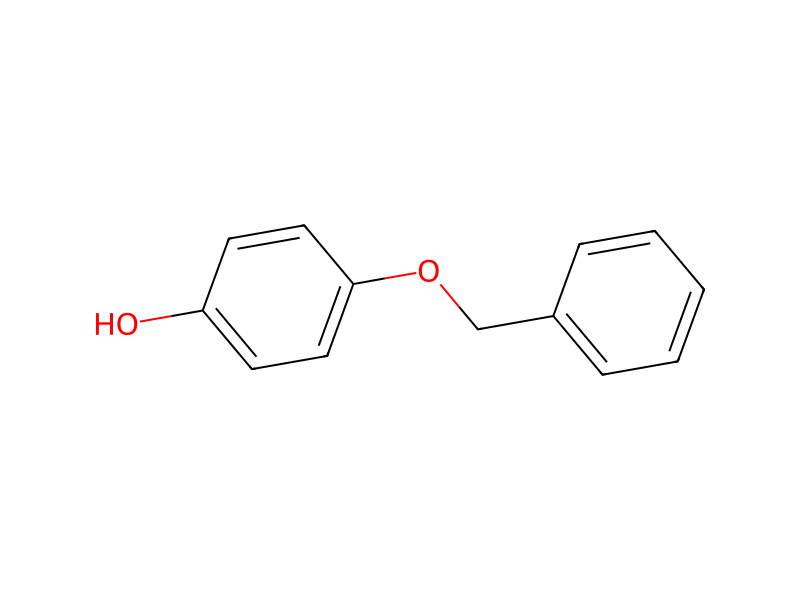


Product 1

Reagents, catalysts & solvents 1

Procedure
A mixture of 4-benzyloxyphenol (50 g), 1,3-dibromopropane (101 g) and powdered anhydrous potassium carbonate (17.3 g) in acetone (500 ml) was stirred under reflux for 30 hours. The solids were removed by filtration and the filtrate was evaporated to dryness in vacuo. The residue was dissolved in 300 ml of dichloromethane and the resulting solution was washed with 10% sodium hydroxide solution to remove unreacted p-benzyloxyphenol. The dichloromethane extract was dried over potassium carbonate, concentrated in vacuo and distilled giving 33.4 g of 1-benzyloxy-4-(3-bromopropoxy)benzene; bp 180°-195° (0.6 mm) (41% yield, 98% pure by gas chromatography). The structure was confirmed by mass spectrum analysis.
Workup
- temperatureunder reflux for 30 hours
- customThe solids were removed by filtration
- customthe filtrate was evaporated to dryness in vacuo
- dissolutionThe residue was dissolved in 300 ml of dichloromethane
- washthe resulting solution was washed with 10% sodium hydroxide solution
- customto remove unreacted p-benzyloxyphenol
- extractionThe dichloromethane extract
- dry with materialwas dried over potassium carbonate
- concentrationconcentrated in vacuo
- distillationdistilled
Sources & evidence
- ORD record
- ord-d71a285d404f41e2944b5ca83a4ecbe8
- Source dataset
- uspto-grants-1984_09
- Patent number
- US04471116
Reaction notes
Loading…