2-Naphthol → Binol
Reaction equation
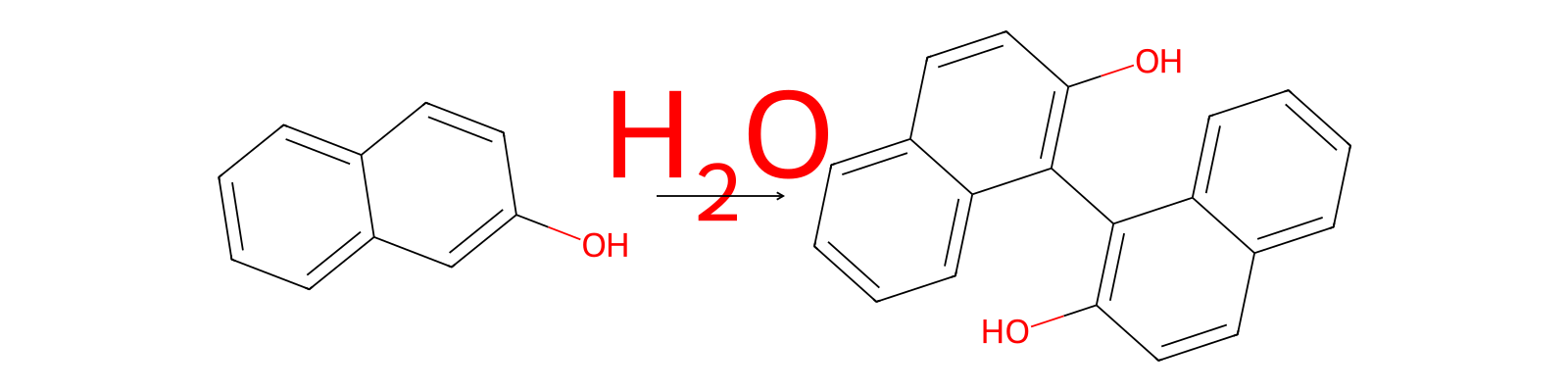
[CH:1]1[C:10]2[C:5](=[CH:6][CH:7]=[CH:8][CH:9]=2)[CH:4]=[CH:3][C:2]=1[OH:11]>O>[OH:11][C:2]1[CH:3]=[CH:4][C:5]2[C:10](=[CH:9][CH:8]=[CH:7][CH:6]=2)[C:1]=1[C:1]1[C:10]2[C:5](=[CH:6][CH:7]=[CH:8][CH:9]=2)[CH:4]=[CH:3][C:2]=1[OH:11]Participants
Reactant 1

Product 1

Reagents, catalysts & solvents 1

Conditions
- Temperature
- 65 °C
Procedure
Add 2 g 2-naphthol, 11.4 g FeCl3.6H2O and 100 ml water into a 200 ml beaker and agitate them at 65° C. by water bath; conduct TLC (thin-layer chromatography) track and maintain the reaction for 3 h; filter the solution to get solid 2,2′-dihydroxyl-1,1′-binaphthyl; scrub 2,2′-dihydroxyl-1,1′-binaphthyl with 50 ml water and add the cleaning solution into the filtrate; add 7.5 ml 30% H2O2 dropwise slowly into the filtrate while agitation and agitate the solution continuously for 10 min; add 2 g 2-naphthol and maintain the reaction at 65° C. while agitation; conduct TLC track until the reaction finishes; filter the solution to obtain 2,2′-dihydroxyl-1,1′-binaphthyl. Repeat these steps and obtain results as shown in Table 6. The HPLC analysis results of the reaction product obtained in the 11th time of cycle are: the conversion of 2-naphthol ≧98%, and the yield of 2,2′-dihydroxyl-1,1′-binaphthyl ≦99%.
Workup
- temperatureconduct TLC (thin-layer chromatography) track and maintain
- customthe reaction for 3 h
- filtrationfilter the solution
Sources & evidence
- ORD record
- ord-1a24d49c47024df19a09bb83898c84af
- Source dataset
- uspto-grants-2011_06
- Patent number
- US07964678B2
Reaction notes
Loading…