(S)-3-(tert-Butoxycarbonylamino)-1-(4-bromo-5-isoquinolinesulfonyl)pyrrolidine → Hydrochloric Acid
Reaction equation
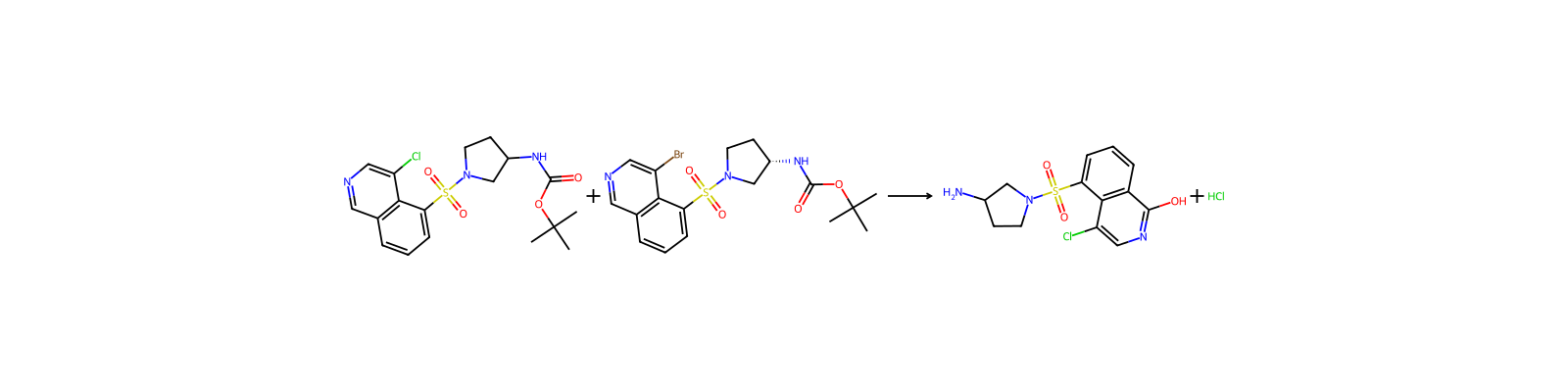
C(OC([NH:8][CH:9]1[CH2:13][CH2:12][N:11]([S:14]([C:17]2[C:18]3[C:19]([Cl:27])=[CH:20][N:21]=[CH:22][C:23]=3[CH:24]=[CH:25][CH:26]=2)(=[O:16])=[O:15])[CH2:10]1)=O)(C)(C)C.C([O:32]C(N[C@H]1CCN(S(C2C3C(Br)=CN=CC=3C=CC=2)(=O)=O)C1)=O)(C)(C)C>>[NH2:8][CH:9]1[CH2:13][CH2:12][N:11]([S:14]([C:17]2[C:18]3[C:19]([Cl:27])=[CH:20][N:21]=[C:22]([OH:32])[C:23]=3[CH:24]=[CH:25][CH:26]=2)(=[O:16])=[O:15])[CH2:10]1.[ClH:27]Participants
4




Procedure
Intermediate 16 can be used in the method of Example 6-1, Step A instead of Intermediate 1a, then the resultant can be used in the method of Step B in a similar manner, and then the title compound can be obtained as hydrochloride according to the method described in Example 7-1.
Sources & evidence
- ORD record
- ord-37e3722f7f384abcbd840e8ea13d84bc
- Source dataset
- uspto-grants-2011_06
- Patent number
- US07964613B2
Reaction notes
Loading…