Triethylamine → HCID 86597427, compound
Reaction equation
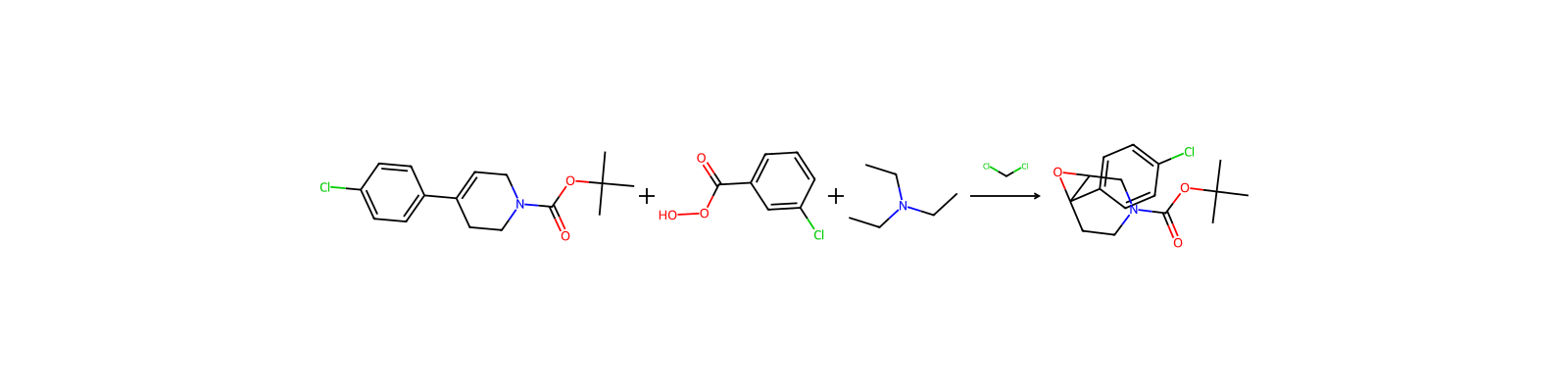
[C:1]([O:5][C:6]([N:8]1[CH2:13][CH:12]=[C:11]([C:14]2[CH:19]=[CH:18][C:17]([Cl:20])=[CH:16][CH:15]=2)[CH2:10][CH2:9]1)=[O:7])([CH3:4])([CH3:3])[CH3:2].ClC1C=CC=C(C(OO)=[O:29])C=1.C(N(CC)CC)C>C(Cl)Cl>[C:1]([O:5][C:6]([N:8]1[CH2:9][CH2:10][C:11]2([C:14]3[CH:19]=[CH:18][C:17]([Cl:20])=[CH:16][CH:15]=3)[CH:12]([O:29]2)[CH2:13]1)=[O:7])([CH3:4])([CH3:2])[CH3:3]Participants
5





Procedure
To a solution of 4-(4-Chloro-phenyl)-3,6-dihydro-2H-pyridine-1-carboxylic acid tert-butyl ester (3.8 g, 13 mmol) in CH2Cl2 (50 mL) was added 3-chloroperbenzoic acid (3.8 g, 17.0 mmol) and triethylamine (3.6 mL, 20 mmol). The solution was stirred at room temperature for about 4 hours. A white precipitate was observed. The reaction was quenched with aqueous sodium bicarbonate, extracted with CH2Cl2, and the organic layers were evaporated in vacuo. The residue was purified by flash chromatography on silica gel (35 g SiO2, gradient elution from 100% hexane to 100% ethyl acetate) to yield the title compound as a colorless oil.
Workup
- customThe reaction was quenched with aqueous sodium bicarbonate
- extractionextracted with CH2Cl2
- customthe organic layers were evaporated in vacuo
- customThe residue was purified by flash chromatography on silica gel (35 g SiO2, gradient elution from 100% hexane to 100% ethyl acetate)
Sources & evidence
- ORD record
- ord-8ab7cb3b9a484269ac2421530f4e3f02
- Source dataset
- uspto-grants-2014_02
- Patent number
- US08653096B2
Reaction notes
Loading…