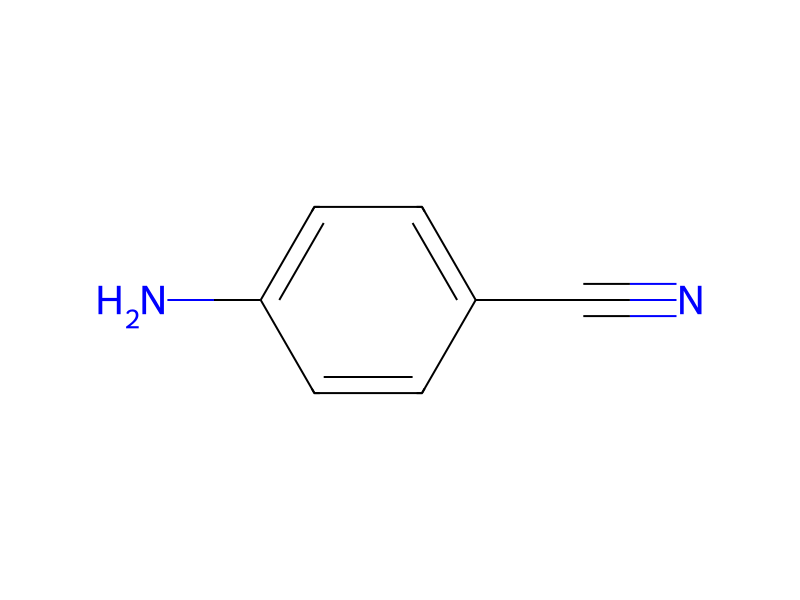
4-Aminobenzonitrile → 4-[(5-Bromo-4,6-dichloropyrimidin-2-yl)amino]benzonitrile
Reaction equation

[Br:1][C:2]1[C:3]([Cl:10])=[N:4][C:5](Cl)=[N:6][C:7]=1[Cl:8].[NH2:11][C:12]1[CH:19]=[CH:18][C:15]([C:16]#[N:17])=[CH:14][CH:13]=1.C(N(C(C)C)CC)(C)C>>[Br:1][C:2]1[C:3]([Cl:10])=[N:4][C:5]([NH:11][C:12]2[CH:19]=[CH:18][C:15]([C:16]#[N:17])=[CH:14][CH:13]=2)=[N:6][C:7]=1[Cl:8]Participants



Procedure
Drugs of the Future 2005, 30(5): 462-468 discloses that 4-guanidinobenzonitrile is cyclized with diethylmalonate by means of sodium ethoxide to give 4-(4,6-dihydroxypyrimidine-2-yl-amino)-benzonitrile, which upon treatment with POCl3 yields the corresponding dichloro derivative. Further bromination with bromine and sodium bicarbonate in aqueous methanol affords 4-(5-bromo-4,6-dichloropyrimidin-2-ylamine)-benzonitrile, which on condensation with the sodium salt of cyano-2,6-dimethylphenolate in presence of N-methylpyrrolidone and dioxane gives 4-[[5-bromo-4-(4-cyano-2,6-dimethylphenoxy)-6-chloro-2-pyrimidinyl]amino]benzonitrile, followed by the aminolysis of the same intermediate yields Etravirine. It also discloses another process in which 5-bromo-2,4,6-trichloropyrimidine is reacted with 4-aminobenzonitrile in presence of diisopropylethylamine to give 4-(5-Bromo-4,6-dichloro-pyrimidin-2-ylamino)-benzonitrile, which is then reacted with 4-hydroxy-3,5-dimethylbenzonitrile to give 4-[[5-bromo-4-(4-cyano-2,6-dimethylphenoxy)-6-chloro-2-pyrimidinyl]amino]benzonitrile. The aminolysis of the same intermediate yields Etravirine.
Sources & evidence
- ORD record
- ord-1ee7b5121c0e40d4a25c3ade1ea062d1
- Source dataset
- uspto-grants-2014_02
- Patent number
- US08653266B2
Reaction notes
Loading…