Dimethyl Sulfide → 4-Amino-5-fluoro-1-(4-methoxyphenylsulfonyl)pyrimidin-2(1H)-one
Reaction equation

FC1C(=N)N(C)C(=O)NC=1.[F:11][C:12]1[C:13](=[NH:31])[N:14](C)[C:15](=[O:29])[N:16]([S:18]([C:21]2[CH:26]=[CH:25][C:24]([O:27][CH3:28])=[CH:23][CH:22]=2)(=[O:20])=[O:19])[CH:17]=1.FC(F)(F)C(O)=O.CSC>>[NH2:31][C:13]1[C:12]([F:11])=[CH:17][N:16]([S:18]([C:21]2[CH:22]=[CH:23][C:24]([O:27][CH3:28])=[CH:25][CH:26]=2)(=[O:19])=[O:20])[C:15](=[O:29])[N:14]=1Participants
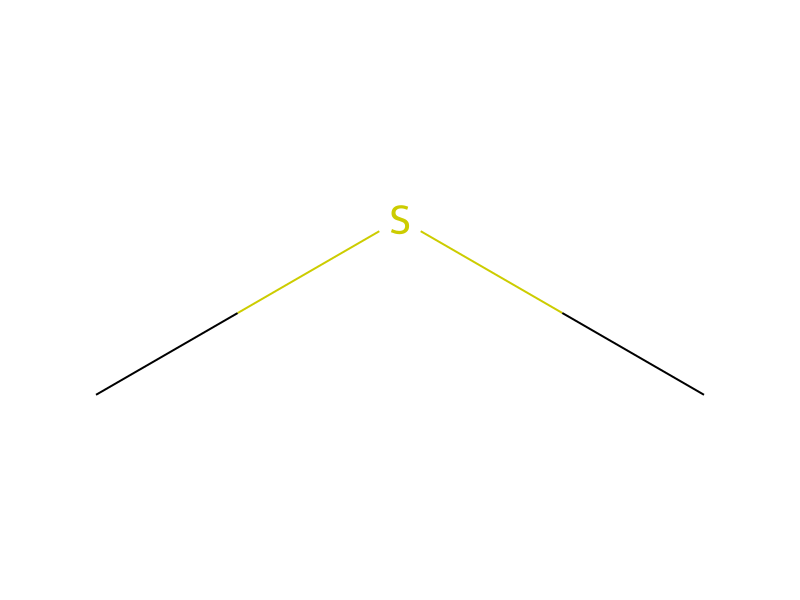


Procedure
To 4-amino-5-fluoro-pyrimidin-2-ol* (1.0 grams (g), 7.75 millimoles (mmol)) in acetonitrile (CH3CN; 50 milliliters (mL)) was added bis-N,O-trimethylsilylacetamide (BSA; 5.7 mL, 23.3 mmol) and the mixture was heated at 70° C. for 1 hour (h) resulting in a clear solution. After cooling to room temperature, 4-methoxybenzene-1-sulfonyl chloride (1.8 g, 8.5 mmol) was added, and the mixture was stirred for 24 h. The solvent was evaporated and the residue was partitioned between ethyl acetate (EtOAc) and brine. The organic phase was dried over magnesium sulfate (MgSO4), filtered, and evaporated to yield the product as a pale yellow solid (1.48 g, 64%): mp 182-5° C.; 1H NMR (300 MHz, CDCl3) δ 8.40 (br s, 1H), 8.11 (d, J=5.9 Hz, 1H), 8.04-7.98 (m, 2H), 7.02-6.96 (m, 2H), 5.77 (br s, 1H), 3.88 (s, 3H); ESIMS m/z 300 ([M+H]+). *4-Amino-5-fluoro-pyrimidin-2-ol can be purchased commercially. Step 2: 5-Fluoro-4-imino-1-(4-methoxyphenylsulfonyl)-3-methyl-3,4-dihydropyrimidin-2(1H)-one. To a 8 mL screw capped vial were added 4-amino-5-fluoro-1-(4-methoxyphenylsulfonyl)-pyrimidin-2(1H)-one (0.293 g, 0.979 mmol), anhydrous potassium carbonate (K2CO3; 0.271 g, 1.96 mmol), and N,N-dimethylformamide (DMF; 4 mL), followed by iodomethane (CH3I; 0.208 g, 1.47 mmol). The reaction vessel was sealed, and the reaction mixture was warmed to 60° C. and stirred for 4 h. The reaction mixture was cooled to room temperature, diluted with EtOAc (20 mL), and washed with water (H2O; 3×10 mL). The organic phase was dried over MgSO4, filtered, and the solvent evaporated under reduced pressure. Purification by flash chromatography (silica gel (SiO2), EtOAc/Hexanes gradient) afforded the title compound as a pale yellow solid (36 mg, 12%): mp 158-162° C.; 1H NMR (400 MHz, DMSO-d6) δ 8.01 (d, J=9.22 Hz, 2H), 7.74 (d, J=5.27 Hz, 1H), 7.04 (d, J=9.23 Hz, 2H), 3.90 (s, 3H), 3.31 (s, 3H); ESIMS m/z 314 ([M+H]+). Step 3: 5-Fluoro-4-imino-3-methyl-3,4-dihydropyrimidin-2(1H)-one (1). A 25 mL screw capped vial was charged with 5-fluoro-4-imino-1-(4-methoxyphenylsulfonyl)-3-methyl-3,4-dihydropyrimidin-2(1H)-one (80.4 mg, 0.257 mmol), trifluoroacetic acid (TFA; 16.0 mL, 215 mmol), and dimethylsulfide (94.0 μL, 1.28 mmol). The resulting solution was allowed to stir at room temperature for 5.5 h and was then concentrated to dryness by rotary evaporation at 30° C. The crude material was then dissolved in a minimal amount of methanol (CH3OH; ˜2 mL) and loaded onto a 5 g normal phase solid load Isco cartridge, rinsing the source vial with CH3OH (3×1 mL). The solid cartridge was then dried under vacuum at room temperature. After drying, the product was purified by chromatography (4 g SiO2 column; 0 to 30% CH3OH in dichloromethane (CH2Cl2) gradient). The material thus obtained was determined to be the 4-methoxysulfonic acid salt of the desired product. The free base was obtained by dissolving the material in CH3OH (4 mL), adding MP-carbonate resin (345 mg, 3.03 mmol/g, 4.0 equiv), and allowing to stir at room temperature. After stirring for 20 h, the solid resin was filtered off and rinsed with CH3OH (3×1 mL). After concentration under high vacuum, 5-fluoro-4-imino-3-methyl-3,4-dihydropyrimidin-2(1H)-one (35.2 milligrams (mg), 96%) was obtained as a 95% pure white solid: mp 181-184° C.; 1H NMR (400 MHz, DMSO-d6) δ 7.48 (d, J=4.1 Hz, 1H), 3.22 (s, 3H); 13C NMR (101 MHz, DMSO-d6) δ 152.19 (s), 151.86 (d, J=27.3 Hz), 136.73 (d, J=221.0 Hz), 129.45 (d, J=26.0 Hz), 28.91 (s).
Workup
- customA 25 mL screw capped vial
- concentrationwas then concentrated to dryness by rotary evaporation at 30° C
- dissolutionThe crude material was then dissolved in a minimal amount of methanol (CH3OH; ˜2 mL)
- washrinsing the source vial with CH3OH (3×1 mL)
- customThe solid cartridge was then dried under vacuum at room temperature
- customAfter drying
- customthe product was purified by chromatography (4 g SiO2 column; 0 to 30% CH3OH in dichloromethane (CH2Cl2) gradient)
- customThe material thus obtained
Sources & evidence
- ORD record
- ord-e2f5a04c1bc14f8fb6107f50c63435f2
- Source dataset
- uspto-grants-2014_02
- Patent number
- US08658660B2
Reaction notes
Loading…