Styrene → Styrene
Reaction equation

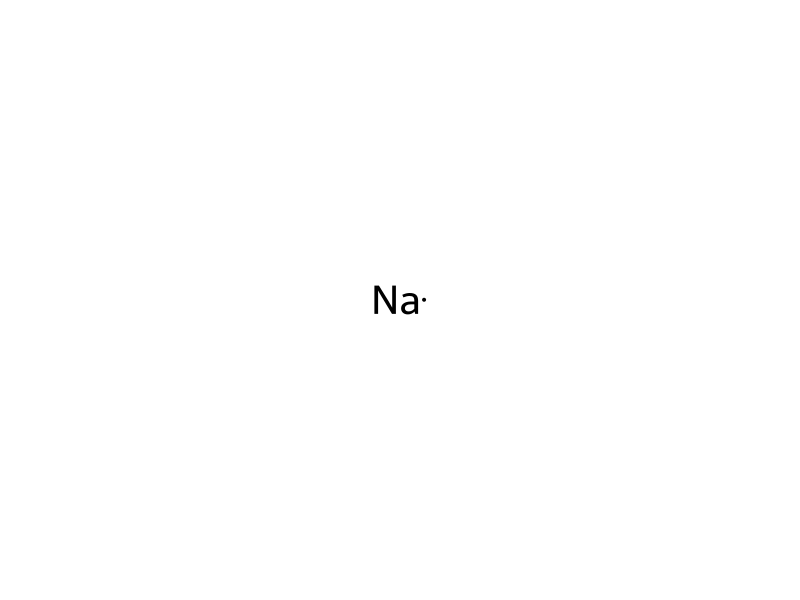
[C:1]1([CH:7]2[CH2:12][CH2:11][CH2:10][CH2:9][CH2:8]2)[CH:6]=[CH:5][CH:4]=[CH:3][CH:2]=1.[Na].[CH2:14]=[CH:15][C:16]1[CH:21]=[CH:20][CH:19]=[CH:18][CH:17]=1>C(O)(C)C>[CH2:8]=[CH:7][C:1]1[CH:6]=[CH:5][CH:4]=[CH:3][CH:2]=1.[C:1]1([CH:7]2[CH2:12][CH2:11][CH2:10][CH2:9][CH2:8]2)[CH:6]=[CH:5][CH:4]=[CH:3][CH:2]=1.[C:1]1([C:7]2([CH2:14][CH2:15][C:16]3[CH:21]=[CH:20][CH:19]=[CH:18][CH:17]=3)[CH2:12][CH2:11][CH2:10][CH2:9][CH2:8]2)[CH:6]=[CH:5][CH:4]=[CH:3][CH:2]=1Participants
Reactant 3


Product 3

Reagents, catalysts & solvents 1

Conditions
- Temperature
- 130 °C
Procedure
A mixture of 3,100 grams (g) of anhydrous phenylcyclohexane, 40 g of metallic sodium and 11 g of isopropyl alcohol was placed in a 5-liter glass flask and heated to 130° C., and 650 g of styrene was dropped over 3 hours while vigorously stirring and subsequently the resulting mixture was stirred for 1 hour to complete the reaction. Stirring was stopped and the reaction mixture was allowed to stand and cool. Then an oil layer was separated and 200 g of ethanol was added. The resulting mixture was washed three times with each of 2 liters (l) of a 5N aqueous solution of hydrochloric acid and 2 l of saturated aqueous solution of sodium chloride, and dried over anhydrous sodium sulfate. The unreacted phenylcyclohexane was distilled away by the use of a rotary evaporater, and the residue was distilled under reduced pressure to yield 850 g of a fraction having a boiling point of 160°-170° C. at 0.3 mmHg (this fraction is hereinafter referred to as "Fraction f-1") and 550 g of a fraction having a boiling point of 210°-220° C. at 0.3 mmHg (this fraction is hereinafter referred to as "Fraction f-2"). An analysis confirmed that the Fraction f-1 was a compound resulting from addition of one styrene molecule to phenylcyclohexane, i.e., 1-phenyl-1-(2-phenylethyl)cyclohexane, and the Fraction f-2 was a compound resulting from addition of two styrene molecules to phenylcyclohexane, i.e., 1-phenyl-1-(2,4-diphenylbutyl)cyclohexane.
Workup
- customwas placed in a 5-liter glass flask
- stirringsubsequently the resulting mixture was stirred for 1 hour
- customthe reaction
- stirringStirring
- temperaturecool
- customThen an oil layer was separated
- addition200 g of ethanol was added
- washThe resulting mixture was washed three times with each of 2 liters (l) of a 5N aqueous solution of hydrochloric acid and 2 l of saturated aqueous solution of sodium chloride
- dry with materialdried over anhydrous sodium sulfate
- distillationThe unreacted phenylcyclohexane was distilled away by the use of a rotary evaporater
- distillationthe residue was distilled under reduced pressure
- customto yield 850 g of a fraction
Sources & evidence
- ORD record
- ord-5842cbd05ef742fb9086b8b1fa9a345c
- Source dataset
- uspto-grants-1987_11
- Patent number
- US04704490
Reaction notes
Loading…