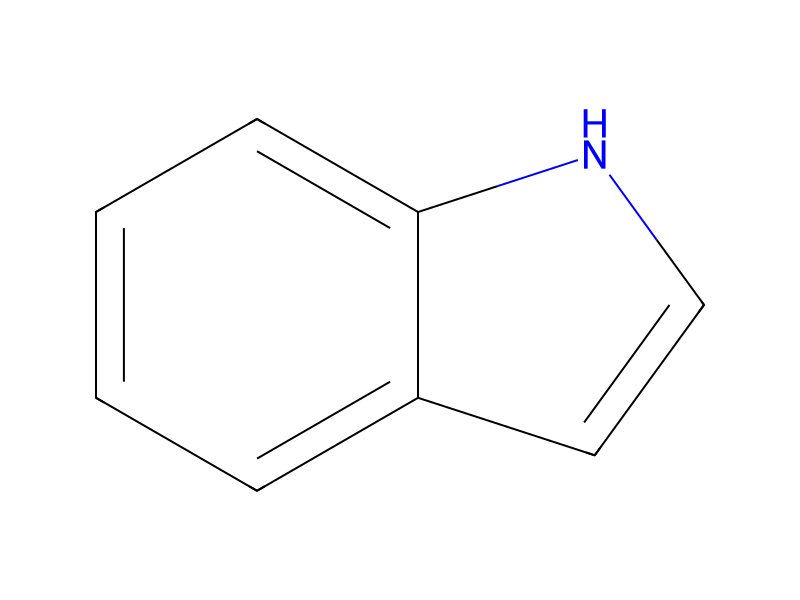
Indole → 3-m-Nitrobenzoylindole
Reaction equation

[N+:1]([C:4]1[CH:5]=[C:6]([CH:10]=[CH:11][CH:12]=1)[C:7](Cl)=[O:8])([O-:3])=[O:2].[Cl-].[Al+3].[Cl-].[Cl-].[NH:17]1[C:25]2[C:20](=[CH:21][CH:22]=[CH:23][CH:24]=2)[CH:19]=[CH:18]1.C(OCC)(=O)C>ClCCl>[N+:1]([C:4]1[CH:5]=[C:6]([CH:10]=[CH:11][CH:12]=1)[C:7]([C:19]1[C:20]2[C:25](=[CH:24][CH:23]=[CH:22][CH:21]=2)[NH:17][CH:18]=1)=[O:8])([O-:3])=[O:2]Participants
Reactant 4



Product 1

Reagents, catalysts & solvents 1

Procedure
A solution of 3-nitrobenzoyl chloride (4.76 g) in dichloromethane (20 ml) was added to a suspension of aluminum chloride (3.42 g) in dichloromethane (50 ml) at 25° C., and the mixture was stirred at the same temperature for an hour. A solution of indole (3.0 g) in dichloromethane (20 ml) was added to the mixture at 25° C. After stirring for an hour at 25° C., the reaction mixture was poured into a mixture of ethyl acetate and ice water. The organic layer was separated, washed with water, and dried over magnesium sulfate. After evaporation of solvent, the crystalline residue was recrystallized from ethyl acetate to give 3-(3-nitrobenzoyl)indole (2.37 g) as pale red crystals. The mother liquid was purified by column chromatography on silica gel (20 g) with chloroform as eluent to give another crystals of 3-(3-nitrobenzoyl)indole (0.277 g).
Workup
- stirringAfter stirring for an hour at 25° C.
- customThe organic layer was separated
- washwashed with water
- dry with materialdried over magnesium sulfate
- customAfter evaporation of solvent
- customthe crystalline residue was recrystallized from ethyl acetate
Sources & evidence
- ORD record
- ord-948135161ad247c08442bfa41733fbe7
- Source dataset
- uspto-grants-1993_05
- Patent number
- US05212320
Reaction notes
Loading…