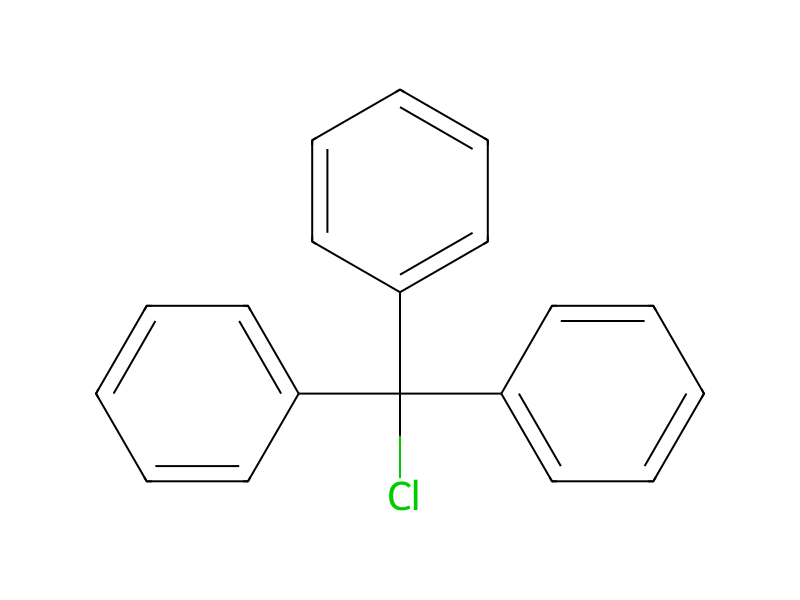
Trityl chloride → Benzene, 1,1',1''-(azidomethylidyne)tris-
Reaction equation

[N-:1]=[N+:2]=[N-:3].[Na+].[C:5](Cl)([C:18]1[CH:23]=[CH:22][CH:21]=[CH:20][CH:19]=1)([C:12]1[CH:17]=[CH:16][CH:15]=[CH:14][CH:13]=1)[C:6]1[CH:11]=[CH:10][CH:9]=[CH:8][CH:7]=1>CN(C)C=O.O>[C:5]([N:1]=[N+:2]=[N-:3])([C:6]1[CH:11]=[CH:10][CH:9]=[CH:8][CH:7]=1)([C:18]1[CH:19]=[CH:20][CH:21]=[CH:22][CH:23]=1)[C:12]1[CH:13]=[CH:14][CH:15]=[CH:16][CH:17]=1Participants
Reactant 2

Product 1

Reagents, catalysts & solvents 2


Procedure
To a suspension of sodium azide (19.0 g : 0.283 Mol.) in dimethyl- formamide (130 ml) is added trityl chloride (76.0 g : 0.273 Mol.), and the mixture is stirred at room temperature for 5 hours. The reaction mixture is diluted with water and extracted with ether. The extract is washed with brine, dried over sodium sulfate, and concentrated to give trityl azide. To a solution of this azide in acetone (300 ml) is added methyl propiolate (24 ml : 0.27 Mol.), and the mixture is heated under reflux for 6 days. The reaction mixture is cooled to the room temperature and diluted with ether. The separating crystals are collected by filtration to give 1-trityl-1,2,3-triazol-4-ylcarboxylic acid methyl ester (62.0 g) as colorless crystals. Yield: 62%. mp. 189° to 190° C. NMR δ (CDCl3) ppm: 3.93(s, 3H), 7.05-7.15(m, 6H), 7.3-7.4(m, 9H), 8.02(s, 1H).
Workup
- extractionextracted with ether
- washThe extract is washed with brine
- dry with materialdried over sodium sulfate
- concentrationconcentrated
Sources & evidence
- ORD record
- ord-160c3f875be64be68e402f044b504058
- Source dataset
- uspto-grants-1993_05
- Patent number
- US05214037
Reaction notes
Loading…