Hydrochloric Acid → 5-(1,3-Dithiolan-2-yl)resorcinol
Reaction equation

Cl.C([O:5][C:6]1[CH:7]=[C:8]([CH:11]=[C:12]([O:14]C(=O)C)[CH:13]=1)[CH:9]=O)(=O)C.[CH2:18]([SH:21])[CH2:19][SH:20].[OH-].[K+]>CCOCC>[S:20]1[CH2:19][CH2:18][S:21][CH:9]1[C:8]1[CH:7]=[C:6]([OH:5])[CH:13]=[C:12]([CH:11]=1)[OH:14]Participants





Procedure
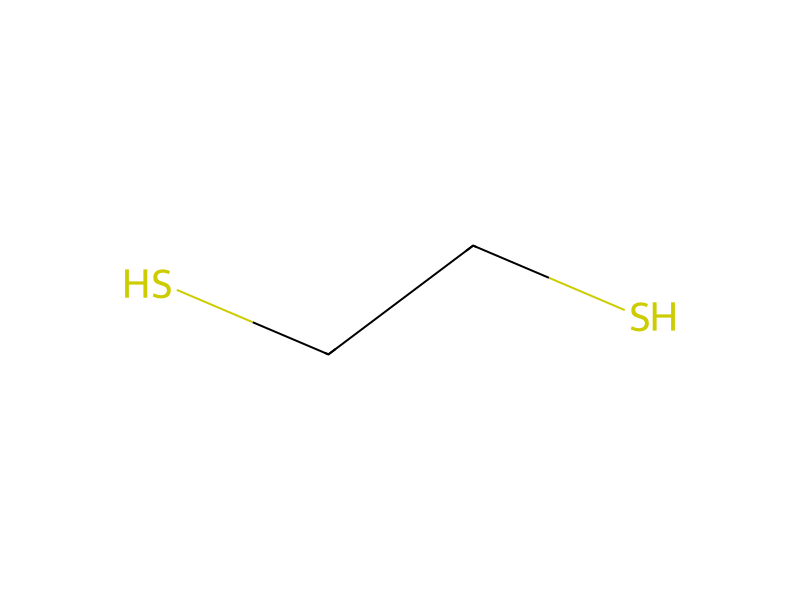
Dry hydrogen chloride was bubbled into a solution of 50.0 g (0.23 mole) of 3,5-diacetoxybenzaldehyde and 21.4 g (0.23 mole) of 1,2-ethanedithiol in 25 ml of ether until the solution became warm. After allowing the solution to stand at ambient temperature for 0.75 hour, the solvent was removed in vacuo and excess methanol was added. A solid of 1,3-diacetoxy-5-(1,3-dithiolan-2-yl)benzene (mp 94°-96° C.) was separated by filtration. It was resuspended in 100 ml of methanol and 21.7 g (0.23 mole) of potassium hydroxide pellets were added. On stirring the mixture at ambient temperature for 0.5 hour, the mixture became homogeneous. The solvent was removed in vacuo and the residue after acidification with 6N hydrochloric acid was extracted with ethyll acetate. The extract was washed with water until neutral, dried and evaporated in vacuo to leave 5-(1,3-dithiolan-2-yl)resorcinol as a gum (41.3 g, 84%) which was used without further purification in the subsequent reaction. The structure was confirmed by the infrared and nuclear magnetic resonance spectra.
Workup
- temperaturebecame warm
- customthe solvent was removed in vacuo and excess methanol
- additionwas added
- customA solid of 1,3-diacetoxy-5-(1,3-dithiolan-2-yl)benzene (mp 94°-96° C.) was separated by filtration
- customThe solvent was removed in vacuo
- extractionthe residue after acidification with 6N hydrochloric acid was extracted with ethyll acetate
- washThe extract was washed with water until neutral,
- customdried
- customevaporated in vacuo
Sources & evidence
- ORD record
- ord-84fafa63ec0f42dda6e7772b8d0605a0
- Source dataset
- uspto-grants-1977_07
- Patent number
- US04036857
Reaction notes
Loading…