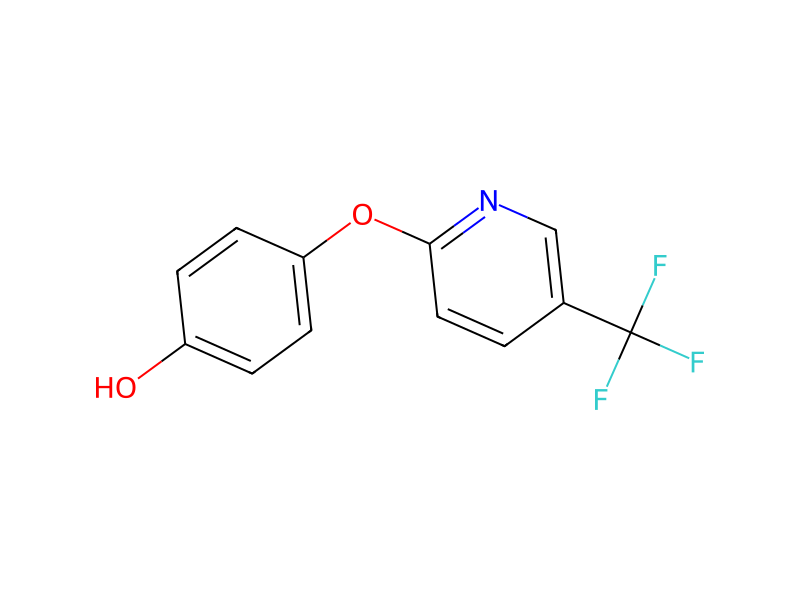
Hydrochloric Acid → 4-(5-Trifluoromethyl-pyridin-2-yloxy)-phenol
Reaction equation

[C:1]1([CH:8]=[CH:7][C:5]([OH:6])=[CH:4][CH:3]=1)[OH:2].Cl[C:10]1[CH:15]=[CH:14][C:13]([C:16]([F:19])([F:18])[F:17])=[CH:12][N:11]=1.[OH-].[K+].Cl>CS(C)=O>[OH:2][C:1]1[CH:8]=[CH:7][C:5]([O:6][C:10]2[CH:15]=[CH:14][C:13]([C:16]([F:19])([F:18])[F:17])=[CH:12][N:11]=2)=[CH:4][CH:3]=1Participants
6





Procedure
40 ml of dimethyl sulfoxide, 4.2 g of hydroquinone, 5.0 g of 2-chloro-5-trifluoromethylpyridine and 2.3 g of potassium hydroxide were reacted at 150° C. for 2 hours with stirring in a nitrogen atmosphere. After the reaction product was allowed to cool, the product was added to a suitable amount of ice-water, neutralized with 30% concentrated hydrochloric acid, and extracted with methylene chloride. The extract was washed with water and dried over anhydrous sodium sulfate. 2.5 g of 2-(4-hydroxyphenoxy)-5-trifluoromethylpyridine (m.p. 82°-84° C.) was obtained by distilling off the methylene chloride.
Workup
- temperatureto cool
- extractionextracted with methylene chloride
- washThe extract was washed with water
- dry with materialdried over anhydrous sodium sulfate
Sources & evidence
- ORD record
- ord-b8ec36cb5f60470cad4e3846f7c0ba9b
- Source dataset
- uspto-grants-1979_05
- Patent number
- US04152328
Reaction notes
Loading…