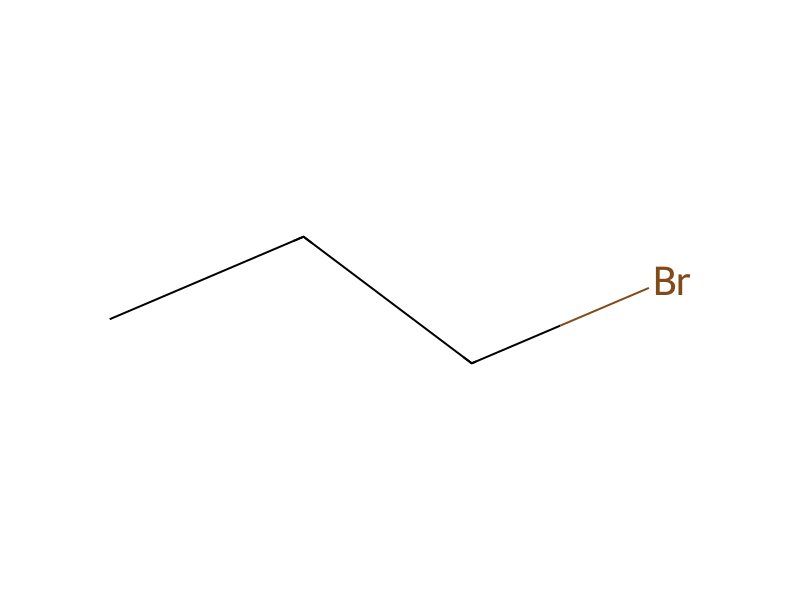
1-Bromopropane → HCID 19033232, compound
Reaction equation

[CH:1]1[C:18]2=[C:19]3[C:8]([C:9]4[C:20]5[C:13](=[CH:14][CH:15]=[CH:16][C:17]2=5)[CH:12]=[CH:11][CH:10]=4)=[CH:7][CH:6]=[C:5]2[C:21]([O:23][C:24](=[O:25])[C:3](=[C:4]23)[CH:2]=1)=[O:22].[CH3:26][C:27](C)([O-])[CH3:28].[K+].CN1C[CH2:36][CH2:35][C:34]1=[O:38].BrCCC>C(O)CC>[CH:7]1[C:8]2=[C:19]3[C:18]([C:17]4[C:20]5[C:13](=[CH:12][CH:11]=[CH:10][C:9]2=5)[CH:14]=[CH:15][CH:16]=4)=[CH:1][CH:2]=[C:3]([C:24]([O:38][CH2:34][CH2:35][CH3:36])=[O:25])[C:4]3=[C:5]([C:21]([O:23][CH2:26][CH2:27][CH3:28])=[O:22])[CH:6]=1Participants
Reactant 4



Product 1

Reagents, catalysts & solvents 1

Procedure
0.18 g (0.56 mmol) of perylene-3,4-dicarboxylic anhydride is suspended in 10 ml of dried n-propanol, 0.15 g (1.43 mmol) of potassium t-butoxide is added, and the suspension is stirred at room temperature for 0.5 hour with the exclusion of moisture. During the course of the reaction, a colour change from brown to yellow can be observed, during which the precipitate dissolves. The solvent is then distilled off, and first 10 ml of N-methylpyrrolidone and then 0.20 ml (2.4 mmol) of 1-bromopropane are added, and the yellow solution is stirred at room temperature for 17 hours. The solvent is distilled off in vacuo, the yellow residue is chromatographed on silica gel using chloroform. Yield 0.16 g (68%), m.p. 253° C., Rf (CHCl3 /silica gel)=0.48. UV (CHCl3): λmax (ε)=460 nm (27944), 437 (23875), 340 (1900), 327 (2050), 260 (32991). Fluorescence (CHCl3):λmax (Irel)=482 nm (1), 509 (0.69), solid fluorescence: λmax =595 nm.
Workup
- customDuring the course of the reaction
- dissolutiondissolves
- distillationThe solvent is then distilled off
- stirringthe yellow solution is stirred at room temperature for 17 hours
- distillationThe solvent is distilled off in vacuo
- customthe yellow residue is chromatographed on silica gel
Sources & evidence
- ORD record
- ord-e7e936f3c6cc4a34854fe76a6090aa61
- Source dataset
- uspto-grants-1997_07
- Patent number
- US05650513
Reaction notes
Loading…