Water → 9-Octadecenoic acid (Z)-, epoxidized, ester with propylene glycol
Reaction equation
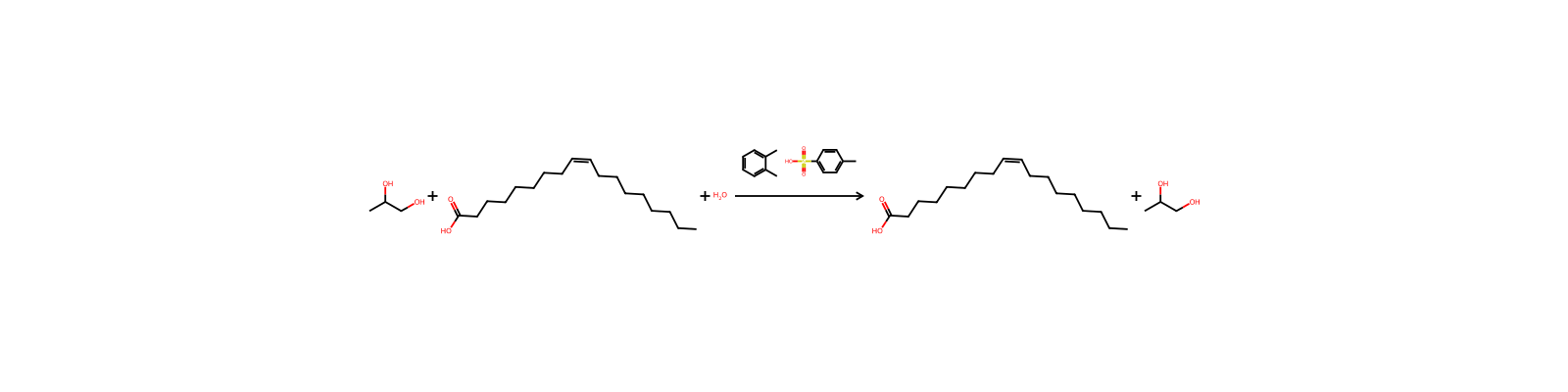
[CH2:1]([OH:5])[CH:2]([OH:4])[CH3:3].[C:6]([OH:25])(=[O:24])[CH2:7][CH2:8][CH2:9][CH2:10][CH2:11][CH2:12][CH2:13]/[CH:14]=[CH:15]\[CH2:16][CH2:17][CH2:18][CH2:19][CH2:20][CH2:21][CH2:22][CH3:23].O>C1(C)C(C)=CC=CC=1.C1(C)C=CC(S(O)(=O)=O)=CC=1>[C:6]([OH:25])(=[O:24])[CH2:7][CH2:8][CH2:9][CH2:10][CH2:11][CH2:12][CH2:13]/[CH:14]=[CH:15]\[CH2:16][CH2:17][CH2:18][CH2:19][CH2:20][CH2:21][CH2:22][CH3:23].[CH2:1]([OH:5])[CH:2]([OH:4])[CH3:3]Participants
6





Procedure
One mole 1,2-propylene glycol is reacted with 0.5 mole oleic acid in one liter of xylene in the presence of 0.01 mole of p-toluene sulfonic acid catalyst. The sample is refluxed under a moisture trap for two hours, poured into ice water, water-washed and the solvent evaporated to provide 70% pure propylene glycol monooleate. The impure product is purified with a silica gel column to provide about 0.35 mole of substantially pure propylene glycol monooleate. The propylene glycol monooleate is present as a mixture of isomeric esters with about 80% of the oleoyl groups at the primary hydroxyl position and 20% at the secondary position of 1,2-propylene glycol.
Workup
- temperatureThe sample is refluxed under a moisture trap for two hours
- washwashed
- customthe solvent evaporated
Sources & evidence
- ORD record
- ord-415125ac049d49848ee8b36a1d8c624d
- Source dataset
- uspto-grants-1976_03
- Patent number
- USRE028728
Reaction notes
Loading…