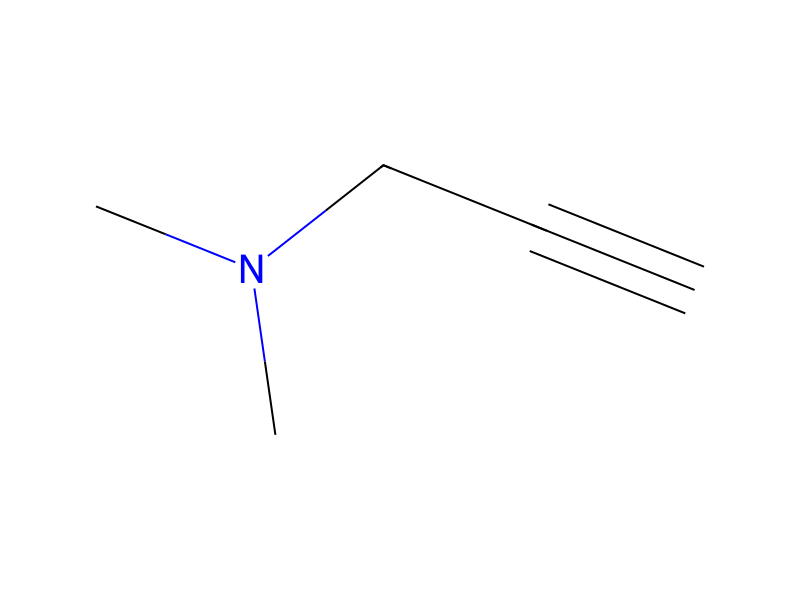
N,N-Dimethylpropargylamine → Dimethyl-[3-(1H-pyrrolo[2,3-b]pyridin-5-yl)-prop-2-ynyl]-amine
Reaction equation

Br[C:2]1[CH:3]=[C:4]2[CH:10]=[CH:9][NH:8][C:5]2=[N:6][CH:7]=1.[CH3:11][N:12]([CH3:16])[CH2:13][C:14]#[CH:15]>CN(C=O)C.C(Cl)Cl.[Cu]I.Cl[Pd](Cl)([P](C1C=CC=CC=1)(C1C=CC=CC=1)C1C=CC=CC=1)[P](C1C=CC=CC=1)(C1C=CC=CC=1)C1C=CC=CC=1>[CH3:11][N:12]([CH3:16])[CH2:13][C:14]#[C:15][C:2]1[CH:3]=[C:4]2[CH:10]=[CH:9][NH:8][C:5]2=[N:6][CH:7]=1Participants
Reactant 2

Product 1

Reagents, catalysts & solvents 4




Procedure
To a screw top tube, 8.1 mg (0.0425 mmoles) of CuI, 18 mg(0.0256 mmoles) of PdCl2(PPh3)2, and 207 mg (0.8483 mmoles) of 5-Bromo-1H-pyrrolo[2,3-b]pyridine were added. The dry solids were diluted with 1 ml of dry DMF and a stream of N2 was bubbled through the solution for 10 minutes and then 182.6 ul(1.7 mmoles) of Dimethyl-prop-2-ynyl-amine was added and the reaction was stirred in a sealed tube overnight at room temperature. The reaction was diluted with 10 ml of DCM and washed with saturated ammonium chloride solution. The organic layer was separated and dried with MgSO4, filtered, and concentrated to dryness yielding a crude material of 189 mg. MS showed a M+ ion of 200.05 which confirmed the structure above. The crude material was taken to the next step.
Workup
- customa stream of N2 was bubbled through the solution for 10 minutes
- washwashed with saturated ammonium chloride solution
- customThe organic layer was separated
- dry with materialdried with MgSO4
- filtrationfiltered
- concentrationconcentrated to dryness
Sources & evidence
- ORD record
- ord-40771809de4344e78270d7a21c6af945
- Source dataset
- uspto-grants-2008_11
- Patent number
- US07446199B2
Reaction notes
Loading…