Triethylamine → trans-2-(5-Bromo-2-chloro-pyrimidin-4-ylamino)-cyclohexanol
Reaction equation

[Br:1][C:2]1[C:3](Cl)=[N:4][C:5]([Cl:8])=[N:6][CH:7]=1.C(N(CC)CC)C.Cl.[NH2:18][C@@H:19]1[CH2:24][CH2:23][CH2:22][CH2:21][C@H:20]1[OH:25]>C(#N)C>[Br:1][C:2]1[C:3]([NH:18][C@@H:19]2[CH2:24][CH2:23][CH2:22][CH2:21][C@H:20]2[OH:25])=[N:4][C:5]([Cl:8])=[N:6][CH:7]=1Participants
5

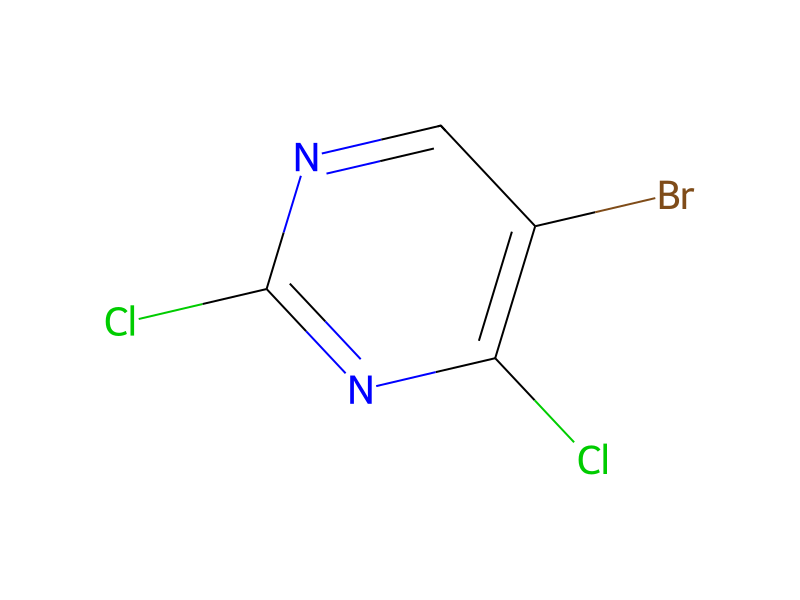



Procedure
An ice-cooled solution of 2.28 g (10.0 mmol) of 5-Bromo-2,4-dichloropyrimidine and 3.4 ml (24.0 mmol) of triethylamine in 10 ml of acetonitrile is mixed with 1.82 g (12.1 mmol) of trans-2-aminocyclohexanol hydrochloride. After 16 hours at room temperature the batch is filtrated and the filtrate is concentrated by evaporation. The remaining residue is purified by chromatography (hexane/ethyl acetate: 1:1). 1.61 g (5.3 mmol, corresponding to 53% of theory) of the product is obtained.
Workup
- filtrationAfter 16 hours at room temperature the batch is filtrated
- concentrationthe filtrate is concentrated by evaporation
- customThe remaining residue is purified by chromatography (hexane/ethyl acetate: 1:1)
- custom1.61 g (5.3 mmol, corresponding to 53% of theory) of the product is obtained
Sources & evidence
- ORD record
- ord-2d6e1f60cf1947a9bcb911090491f438
- Source dataset
- uspto-grants-2008_11
- Patent number
- US07456191B2
Reaction notes
Loading…