2-Phenylethanol → HCID 10087609, compound
Reaction equation

[CH3:1][O:2][C:3]([C:5]1[C:6](=[O:16])[O:7][C:8]2[C:13]([CH:14]=1)=[CH:12][CH:11]=[C:10]([OH:15])[CH:9]=2)=[O:4].[C:17]1([CH2:23][CH2:24]O)[CH:22]=[CH:21][CH:20]=[CH:19][CH:18]=1.C1(P(C2C=CC=CC=2)C2C=CC=CC=2)C=CC=CC=1.N(C(OCC)=O)=NC(OCC)=O>O1CCCC1>[CH3:1][O:2][C:3]([C:5]1[C:6](=[O:16])[O:7][C:8]2[CH:9]=[C:10]([O:15][CH2:24][CH2:23][C:17]3[CH:22]=[CH:21][CH:20]=[CH:19][CH:18]=3)[CH:11]=[CH:12][C:13]=2[CH:14]=1)=[O:4]Participants
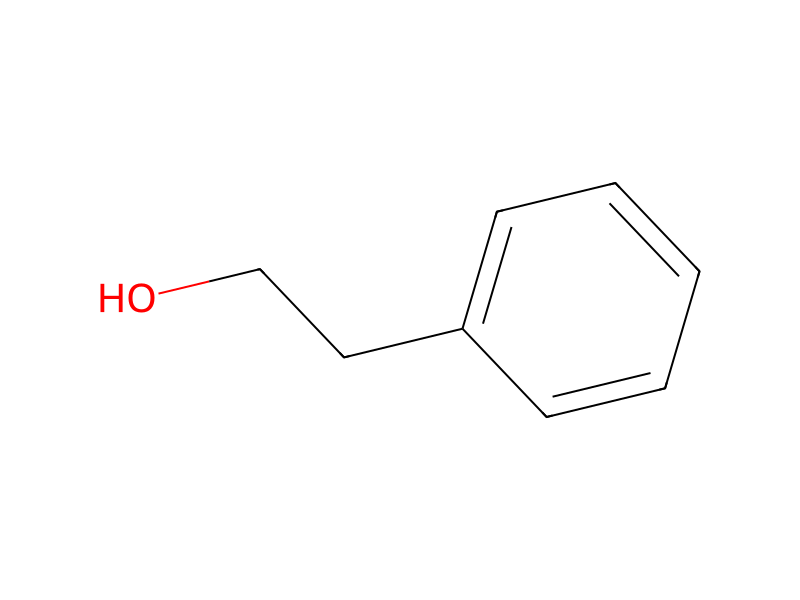





Procedure
7-hydroxyl-3-coumarin carboxylic acid methyl ester (0.6g, 3 mmol) and 2-phenyl ethanol (0.36 mL, 3 mmol) are dissolved in anhydrous tetrahydrofuran (60 mL). Triphenylphosphine (1.2 g, 4.5 mmol) is added, and diethyl azodicarboxylate (0.72 mL, 4.5 mmol) is added dropwise and slowly at 0° C. The resulting solution is stirred for 24 hours at room temperature. After the solvent was removed under reduced pressure, the residue is diluted with methanol and a white solid is separated out. The solid is recrystallized with methanol to give 0.45 g of the captioned compound, yield: 46.3%. m.p. 100-101° C. 1H NMR(CDCl3): δ=3.12(t, J=6.8 Hz, 2H), 3.92(s, 3H), 4.14(t, J=7.1 Hz, 2H), 6.79(d, J=2.4 Hz, 1H), 6.88(dd, J=2.4 Hz, 8.8 Hz, 1H), 7.21-7.35(m, 5H), 7.47(d, J=8.7 Hz, 1H), 8.50(s, 1H); Element Anyalysis, C19H16O5 (324): Calculated C, 70.37; H, 4.94. Found C, 70.25; H, 4.93; IR(KBr) :3045.1, 2952.5, 1751.1, 1693.2, 1610.3, 1554.4, 1506.2, 1436.7, 1375, 1307.5, 1222.7, 1114.7, 1018.2, 835, 749.5, 738.6, 700, 594 cm−1; EI-MS(m/z): 324(24, M+), 105(100).
Workup
- customAfter the solvent was removed under reduced pressure
- additionthe residue is diluted with methanol
- customa white solid is separated out
- customThe solid is recrystallized with methanol
Sources & evidence
- ORD record
- ord-cf618d31fbd34afb8600c9cbbdb9b26e
- Source dataset
- uspto-grants-2008_11
- Patent number
- US07456205B2
Reaction notes
Loading…