Sodium hydride → 2-chloro-N-(isoxazol-3-yl)methyl-N-(2,6-dimethylphenyl)acetamide
Reaction equation

[Cl:1][CH2:2][C:3]([NH:5][C:6]1[C:11]([CH3:12])=[CH:10][CH:9]=[CH:8][C:7]=1[CH3:13])=[O:4].Br[CH2:15][C:16]1[CH:20]=[CH:19][O:18][N:17]=1.[H-].[Na+]>CN(C)C=O>[Cl:1][CH2:2][C:3]([N:5]([CH2:15][C:16]1[CH:20]=[CH:19][O:18][N:17]=1)[C:6]1[C:11]([CH3:12])=[CH:10][CH:9]=[CH:8][C:7]=1[CH3:13])=[O:4]Participants
5

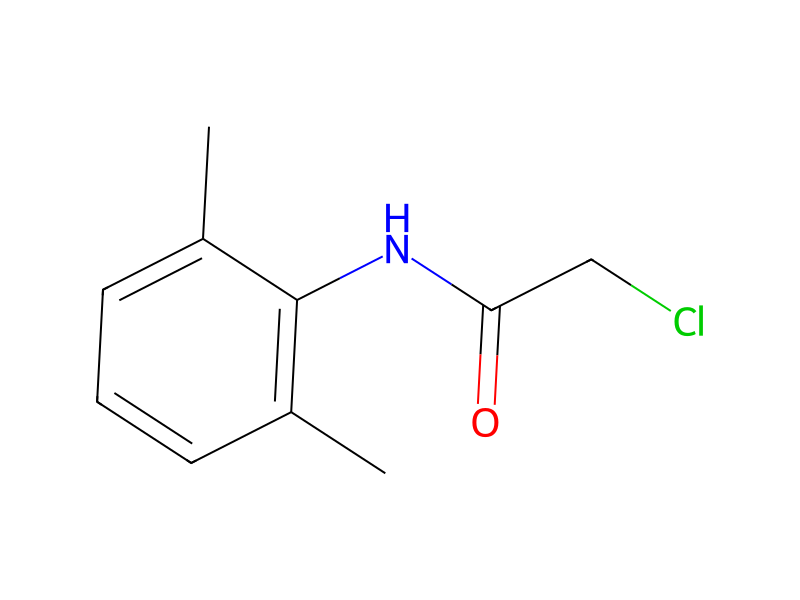



Procedure
A mixture of 6.1 g N-chloroacetyl-2,6-dimethylaniline and 5 g 3-bromomethylisoxazole (prepared as in Example 6 above) in 200 ml dry dimethylformamide was treated with 1.5 g sodium hydride as in Example 3 above. After workup, the solid product was purified by column and high-pressure liquid chromatography to yield a pure product, m.p. 78°-81° C. This product is shown as Compound 2 in Table I. C14H15ClN2O2 : calc., %C 60.32, %H 5.39, %N 10.05; found, %C 60.72, %H 5.71, %N 8.85.
Workup
- customAfter workup, the solid product was purified by column and high-pressure liquid chromatography
- customto yield a pure product, m.p. 78°-81° C
Sources & evidence
- ORD record
- ord-865d1a1ecb8f4ee79b385fa61a1a521e
- Source dataset
- uspto-grants-1980_09
- Patent number
- US04221584
Reaction notes
Loading…