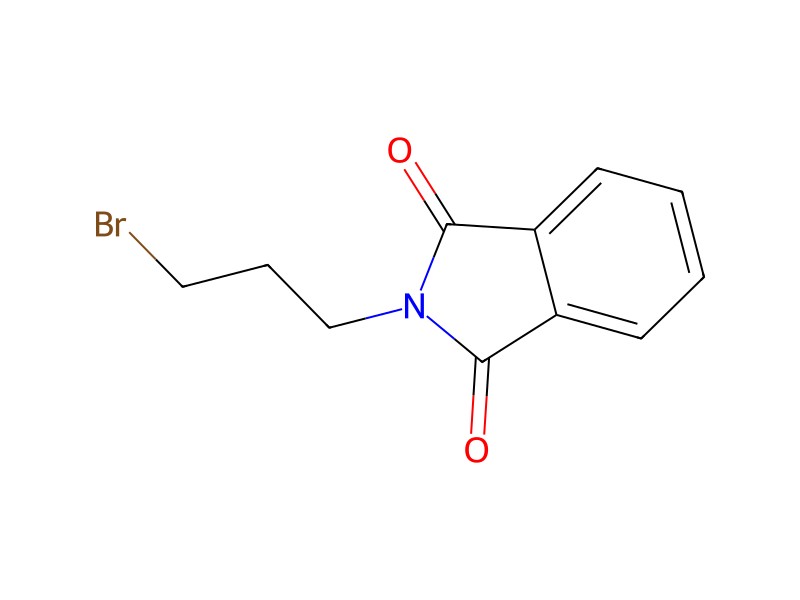
N-3-Bromopropylphthalimide → 4-(3-Phthalimidopropyloxy)pyridine
Reaction equation

[OH:1][C:2]1[CH:7]=[CH:6][N:5]=[CH:4][CH:3]=1.Br[CH2:9][CH2:10][CH2:11][N:12]1[C:16](=[O:17])[C:15]2=[CH:18][CH:19]=[CH:20][CH:21]=[C:14]2[C:13]1=[O:22].C1CCN2C(=NCCC2)CC1>CN(C=O)C>[C:13]1(=[O:22])[N:12]([CH2:11][CH2:10][CH2:9][O:1][C:2]2[CH:7]=[CH:6][N:5]=[CH:4][CH:3]=2)[C:16](=[O:17])[C:15]2=[CH:18][CH:19]=[CH:20][CH:21]=[C:14]12Participants
5




Procedure
To a solution of 4.76 g (50 mmol) of 4-hydroxypyridine and 14.75 g (55 mmol) of N-(3-bromopropyl)phthalimide in 80 ml of DMF was added 8.23 ml (55 mmol) of 1,8-diazabicyclo[5.4.0]-7-undecene. The mixture was stirred at room temperature for 6 hours. After the solvent was distilled off, the mixture was poured into water and extracted with ethyl acetate. The mixture was washed with water and dried over anhydrous magnesium sulfate, and the solvent was distilled off. The residue was purified by column chromatography (eluent: ethyl acetate) to obtain 2.32 g of the desired compound (yield: 16.4% colorless crystals).
Workup
- distillationAfter the solvent was distilled off
- additionthe mixture was poured into water
- extractionextracted with ethyl acetate
- washThe mixture was washed with water
- dry with materialdried over anhydrous magnesium sulfate
- distillationthe solvent was distilled off
- customThe residue was purified by column chromatography (eluent: ethyl acetate)
Sources & evidence
- ORD record
- ord-2dafe5227f2d4b8c84b36f76fba6ae55
- Source dataset
- uspto-grants-1995_02
- Patent number
- US05389658
Reaction notes
Loading…