Bromoacetyl bromide → HCID 13457739, compound
Reaction equation

[Br:1][CH2:2][C:3](Br)=[O:4].Br.[C:7]([C:15]1[N:16]([NH:20][CH3:21])[CH:17]=[CH:18][CH:19]=1)(=[O:14])[C:8]1[CH:13]=[CH:12][CH:11]=[CH:10][CH:9]=1.C(=O)(O)[O-].[Na+]>ClCCl>[CH3:21][N:20]([N:16]1[CH:17]=[CH:18][CH:19]=[C:15]1[C:7](=[O:14])[C:8]1[CH:9]=[CH:10][CH:11]=[CH:12][CH:13]=1)[C:3](=[O:4])[CH2:2][Br:1]Participants
5
Reactant 3
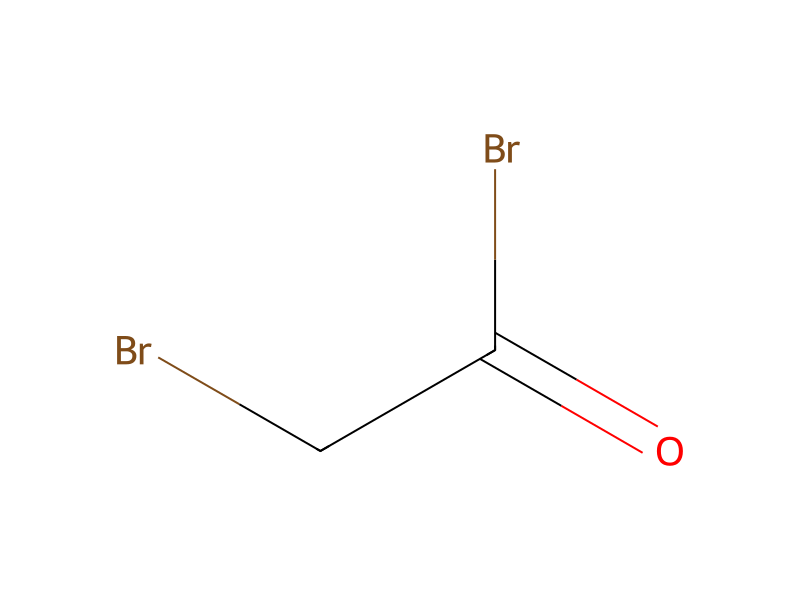


Product 1

Reagents, catalysts & solvents 1

Procedure
A solution of bromoacetyl bromide (8.47 g, 42 mmol) in 30 ml of dichloromethane was added over 30 minutes to a stirred slurry containing 2-benzoyl-1-methylaminopyrrole hydrobromide (14.9 g, 54.7 mmol) and sodium bicarbonate (5.9 g, 71 mmol) in 150 ml of dichloromethane. After 22 hours at room temperature the mixture was quenched with 150 ml of crushed ice and the layers were separated. The organic layer was washed with water, dried over anhydrous MgSO4, filtered and evaporated. The residual oil was flash chromatographed (silica gel, 5% hexane-ethyl acetate) to give 11.0 g (98%) of crystals, m.p. 76°-78°. A 2.2 g portion of this material was recrystallized from ether-hexane to afford 2.1 g of cubes, m.p. 76°-78°.
Workup
- customAfter 22 hours at room temperature the mixture was quenched with 150 ml of crushed ice
- customthe layers were separated
- washThe organic layer was washed with water
- dry with materialdried over anhydrous MgSO4
- filtrationfiltered
- customevaporated
- customchromatographed (silica gel, 5% hexane-ethyl acetate)
Sources & evidence
- ORD record
- ord-d5475fb2df4d4e07bdee9c5d61d4e60a
- Source dataset
- uspto-grants-1986_05
- Patent number
- US04588727
Reaction notes
Loading…