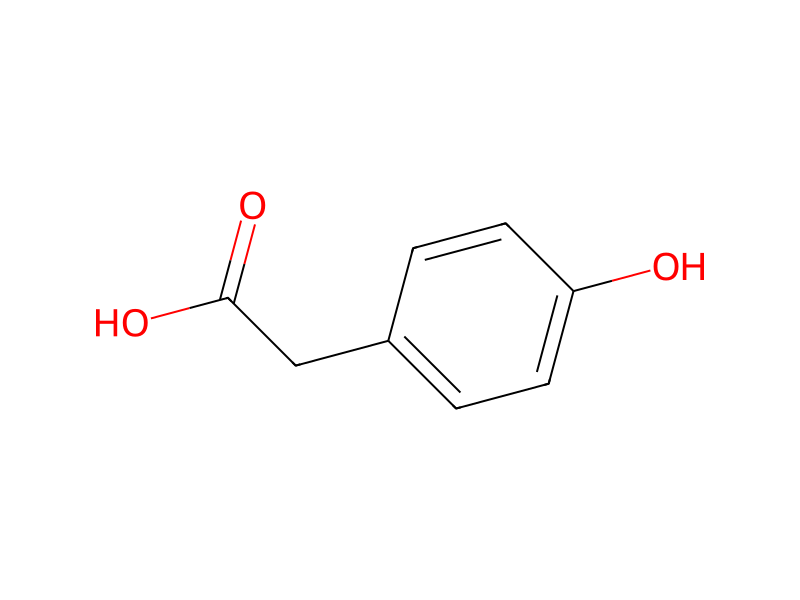
Hydroxyphenylacetic acid → 3-[((4-Chloroanilino)carbonyl)methyl]phenol
Reaction equation

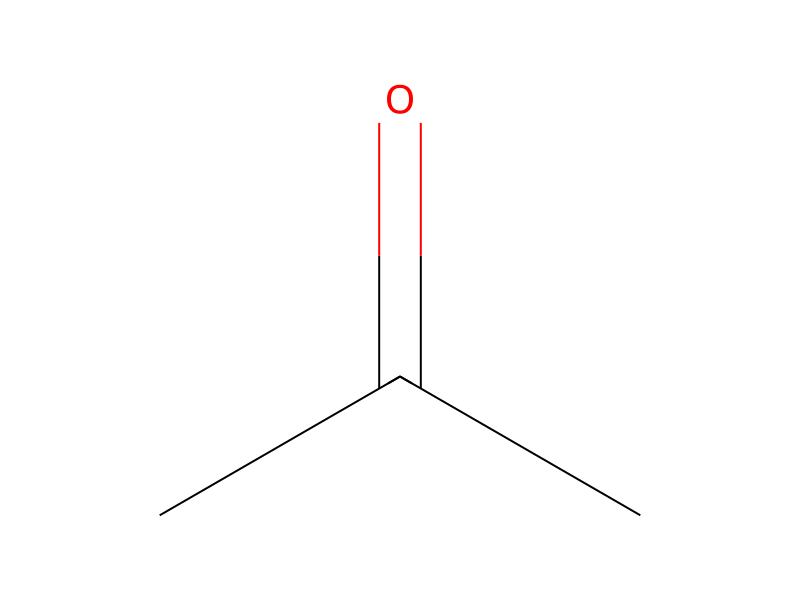
[CH3:1][C:2]([CH3:4])=[O:3].[OH:5][C:6]1C=[CH:10][C:9](CC(O)=O)=[CH:8][CH:7]=1.[Cl:16][C:17]1[CH:23]=[CH:22][C:20]([NH2:21])=[CH:19][CH:18]=1.P(Cl)(Cl)(Cl)(Cl)Cl>C1(C)C=C(C)C=C(C)C=1.C(C(CC)=O)C>[Cl:16][C:17]1[CH:23]=[CH:22][C:20]([NH:21][C:6]([CH2:7][C:8]2[CH:1]=[C:2]([OH:3])[CH:4]=[CH:10][CH:9]=2)=[O:5])=[CH:19][CH:18]=1Participants


Procedure
FIG. 6b presents a similar reaction scheme to FIG. 6a, except that 3- rather than 4-hydroxyphenylacetic acid (HPAA) is used as the precursor material so that the final compound has a meta rather than a para substitution. In addition, rather than reacting with acetone (dimethyl ketone) a diethyl ketone is used to position ethyl, rather than methyl, moieties in the group substituted on one of the phenyl rings. By example, 1.5g (10mmol) 3-HPAA and 2.6g (20 mmol) 4-chloroaniline in 20 ml of mesitylene was heated to reflux. Then 0.33 g (2.55 mmol) PCl5 was then slowly added to the above refluxing solution and the refluxing was continued for two hours. The reaction mixture was then cooled and then worked up as described above to yield 2.2 g (90% yield) of 3-[((4-chloroanilino) carbonyl)methyl]phenol. As described above, chloroform (0.8 ml) was added to a stirred and ice-cooled mixture of 1.23 grams of 3-[((4-chloroanilino)carbonyl)methyl]phenol and 1.6 g NaOH in 15 ml of acetone. The reaction mixture was allowed to warm to room temperature and stirring continued for an additional 10 hours. The usual work-up yielded 2-[3-(((4-chloroanalino)carbonyl)methyl)]phenoxy!-2-methylpropionic acid as a low temperature melting sticky solid (C,H,Cl,N analysis yielded (C18H18ClNO4); NMR δPPM: 1.42 (6H, s, CH3), 3.61 (2H, s, benzylic CH2), and 6.6-7.75 (8H, m, aromatic H)). However, rather than using acetone as the reaction solvent, diethylketone can be used in the same manner as described above to yield the butanoic acid (as opposed to propanoic acid) structure shown in FIG. 6b.
Workup
- temperatureThe reaction mixture was then cooled
Sources & evidence
- ORD record
- ord-628fb4c02d854452b86ab6726458ce3f
- Source dataset
- uspto-grants-1998_03
- Patent number
- US05731454
Reaction notes
Loading…