Benzoic Acid → Diphenyl Ether
Reaction equation

[C:1]1([OH:7])[CH:6]=[CH:5][CH:4]=[CH:3][CH:2]=1.C(O)(=O)[C:9]1[CH:14]=[CH:13][CH:12]=[CH:11][CH:10]=1>[Cu]>[C:1]1([O:7][C:9]2[CH:14]=[CH:13][CH:12]=[CH:11][CH:10]=2)[CH:6]=[CH:5][CH:4]=[CH:3][CH:2]=1Participants
Reactant 2
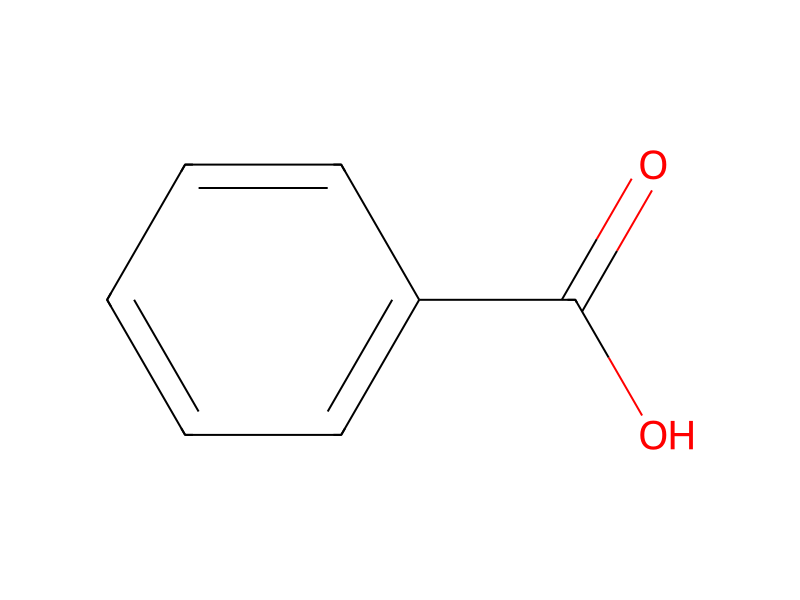

Product 1

Reagents, catalysts & solvents 1

Procedure
However, the catalyst disclosed in Japanese Patent KOKAI No. 57-11932 is insufficient in the yield of phenol. Actually, the maximum conversion of benzoic acid was 50.5%, and the maximum selectivity to phenol was 88.6%, and therefore, the maximum yield was 44.7%. Besides, when an exothermic reaction is conducted such as the oxidation reaction of benzoic aicd using the catalyst containing a copper compound, hot spots occur in the catalyst layer to progress calcining of the catalyst. As a result, the catalytic activity is degraded sharply. In the manufacturing process disclosed in Japanese Patent KOKOKU No. 59-20384, the yield of phenol is insufficient. That is, the maximum conversion of benzoic acid was 63.7%, and the maximum selectivity to phenol was 82.2%, and therefore, the maximum yield was 52.4%. Moreover, byproducts such as diphenyl oxide are produced abundantly, and therefore, a purification process for the produced phenol is necessary. In the manufacturing process disclosed in Japanese Patent KOKOKU No. 64-934, the maximum conversion of benzoic acid was 75%, and the maximum selectivity to phenol was 89%. Therefore, the maximum yield was 66.8%. Moreover, all of the above conventional processes are inferior in productivity due to low space time yield (the production amount of phenol per unit volume of catalyst per unit time), and therefore, they are disadvantageous in the industrial production of phenol.
Workup
- customBesides, when an exothermic reaction
Sources & evidence
- ORD record
- ord-34d70717ec884146ac6ec59b6979b8d1
- Source dataset
- uspto-grants-1993_12
- Patent number
- US05268512
Reaction notes
Loading…