Phosphorus oxychloride → 5-(Hexadecyloxy)thiophene-2-carbaldehyde
Reaction equation

CN([CH:9]=[O:10])C1C=CC=CC=1.P(Cl)(Cl)(Cl)=O.[CH2:16]([O:32][C:33]1[S:34][CH:35]=[CH:36][CH:37]=1)[CH2:17][CH2:18][CH2:19][CH2:20][CH2:21][CH2:22][CH2:23][CH2:24][CH2:25][CH2:26][CH2:27][CH2:28][CH2:29][CH2:30][CH3:31]>>[CH2:16]([O:32][C:33]1[S:34][C:35]([CH:9]=[O:10])=[CH:36][CH:37]=1)[CH2:17][CH2:18][CH2:19][CH2:20][CH2:21][CH2:22][CH2:23][CH2:24][CH2:25][CH2:26][CH2:27][CH2:28][CH2:29][CH2:30][CH3:31]Participants

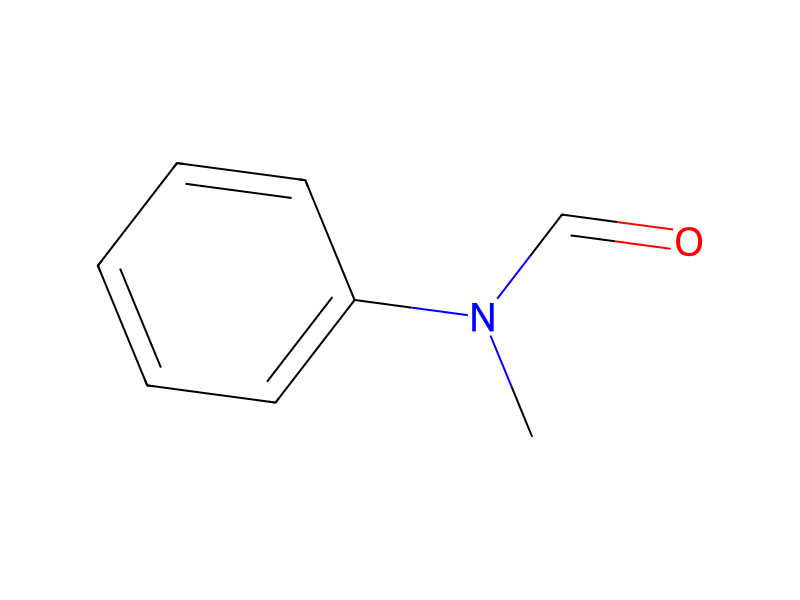


Conditions
- Temperature
- 70 °C
Procedure
To a cooled mixture of 27 g of N-methylformanilide and 27 g (0.176 mole) of phosphorus oxychloride is added 32.5 g (0.1 mole) of 2-hexadecyloxythiophene. The mixture is warmed to 70° C under vacuum (10 mm Hg). The mixture is allowed to stand at 60°-70° C for 7 hours, the overnight at room temperature after which the mixture is stirred into 100 g of ice. The mixture is extracted into benzene, washed with water, dried over sodium sulfate and distilled in vacuo to give 5-hexadecyloxy-2-thiophenecarboxaldehyde. The carboxaldehyde (7.1 g, 0.02 mole) is stirred vigorously with 4 g of potassium hydroxide in 2.6 ml of water for 24 hours. The mixture is diluted with water and extracted into ether. The aqueous layer is separated and acidified with hydrochloric acid precipitating 5-(hexadecyloxy)-2-thiophenecarboxylic acid.
Workup
- extractionThe mixture is extracted into benzene
- washwashed with water
- dry with materialdried over sodium sulfate
- distillationdistilled in vacuo
Sources & evidence
- ORD record
- ord-cbc5e6d38f4f49a584d12ad8cf9b2c3f
- Source dataset
- uspto-grants-1977_04
- Patent number
- US04017514
Reaction notes
Loading…