Potassium Persulfate → 1-Nitroanthraquinone
Reaction equation

C([O-])(=O)C.[K+].S(OOS([O-])(=O)=O)([O-])(=O)=O.[K+].[K+].[N+:18]([CH:21]1[C:34]2[C:33](=[O:35])[C:32]3[C:27](=[CH:28][CH:29]=[CH:30][CH:31]=3)[C:26](=[O:36])[C:25]=2[CH:24]=[CH:23][CH2:22]1)([O-:20])=[O:19]>O>[N+:18]([C:21]1[C:34]2[C:33](=[O:35])[C:32]3[C:27](=[CH:28][CH:29]=[CH:30][CH:31]=3)[C:26](=[O:36])[C:25]=2[CH:24]=[CH:23][CH:22]=1)([O-:20])=[O:19]Participants
5
Reactant 3
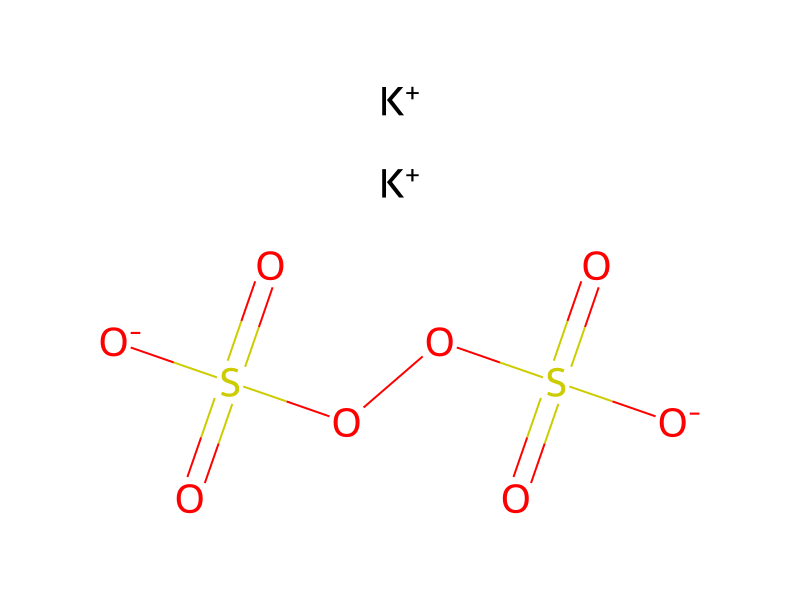


Product 1

Reagents, catalysts & solvents 1

Procedure
With stirring, 0.38 part (3.89 mmol) of potassium acetate is dissolved in 5 parts of glacial acid at 90° C. Then 2.1 parts (7.77 mmol; 4 equivalents) of potassium persulfate are added, whereupon a white suspension forms. Then 1.0 g (3.84 mmol) of nitrodihydroanthraquinone is added. After stirring for 3 hours at 90° C., the mixture is cooled and poured into 50 ml of water. The precipitate is isolated by filtration, washed with water, and dried. The residue is extracted by boiling 3 times in toluene. Partial concentration of the mother liquors and subsequent cooling and filtration give 0.84 part (86% of theory) of 1-nitroanthraquinone with a melting point of 228°-230° C.
Workup
- stirringAfter stirring for 3 hours at 90° C.
- temperaturethe mixture is cooled
- customThe precipitate is isolated by filtration
- washwashed with water
- customdried
- extractionThe residue is extracted
- concentrationPartial concentration of the mother liquors
- temperaturesubsequent cooling
- filtrationfiltration
Sources & evidence
- ORD record
- ord-b0c0dcff660047f492cefe1d9b118ad7
- Source dataset
- uspto-grants-1990_01
- Patent number
- US04892686
Reaction notes
Loading…