Sodium Chloride → 5'-Thymidylic acid
Reaction equation

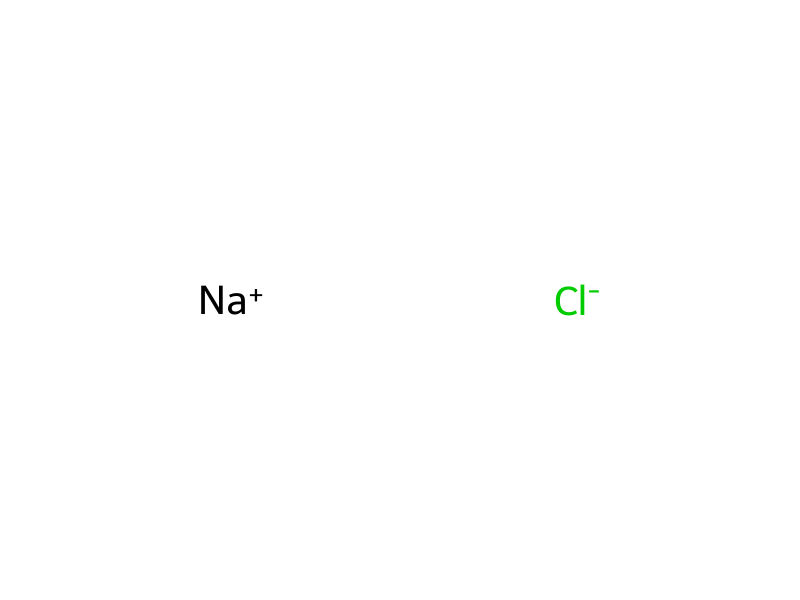
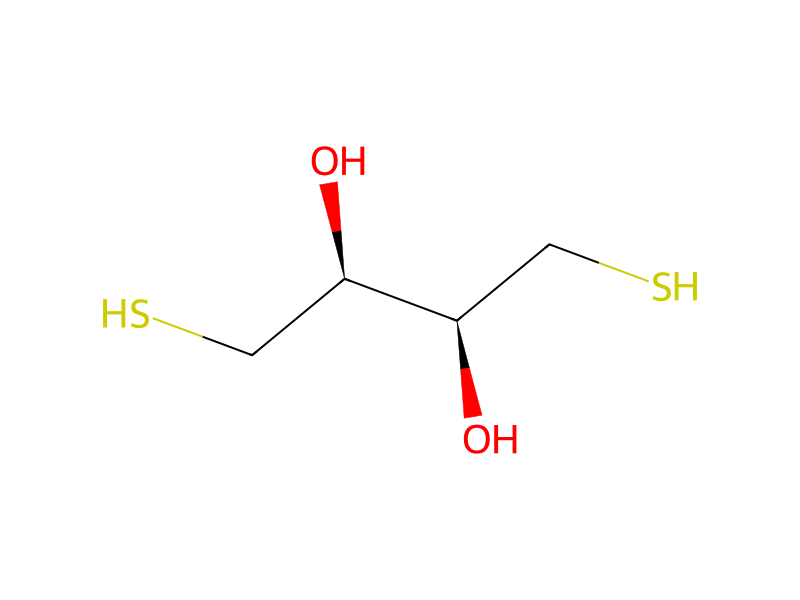
[CH2:1]([OH:8])[C:2]([NH2:7])([CH2:5][OH:6])[CH2:3][OH:4].[ClH:9].[Mg+2].[Cl-].[Cl-].[Na+].[Cl-].[As](C)(C)(=O)[O-].[Na+].SC[C@H]([C@@H](CS)O)O.[OH:29][P:30](=[O:57])([O:40][CH2:41][C@H:42]1[O:56][C@@H:46]([N:47]2[CH:53]=[C:51]([CH3:52])[C:50](=[O:54])[NH:49][C:48]2=[O:55])[CH2:45][C@@H:43]1[OH:44])[O:31]P(=O)(OP(=O)(O)O)O>>[CH2:1]([OH:8])[C:2]([NH2:7])([CH2:5][OH:6])[CH2:3][OH:4].[ClH:9].[CH3:52][C:51]1[C:50](=[O:54])[NH:49][C:48](=[O:55])[N:47]([C@@H:46]2[O:56][C@H:42]([CH2:41][O:40][P:30]([OH:31])([OH:57])=[O:29])[C@@H:43]([OH:44])[CH2:45]2)[CH:53]=1Participants




Procedure
First, a vector primer is synthesized. A vector, e.g. pcDV1, is treated with KpnI in an adequate solution such as a solution consisting of Tris-HCl buffer (e.g. pH 7.5, 10 mM), MgCl2 (e.g. 6 mM) and NaCl (e.g. 10 mM) to cut pcDV1 at KpnI site. The DNA is incubated with terminal deoxynacleotidyltransferase at an appropriate temperature (e.g. 37° C.) for an appropriate period (e.g. 20 minutes) in a solution consisting of Tris-HCl buffer (e.g. pH 6.8, 30 mM), sodium cacodylate (e.g. 140 mM), CoCl2 (e.g. 1 mM), dithiothreitol (e.g. 0.1 mM) and dTTP (e.g. 0.25 mM) to add about 60 thymidyl residues to the both 3' ends of the vector DNA. Then, the DNA is cut with EcoRI in a solution consisting of Tris-HCl buffer (e.g. pH 7.5, 10 mM), MgCl2 (e.g. 6 mM) and NaCl (e.g. 100 mM) The digested solution is fractionated by low-gelling-temperature agarose gel electrophoresis [Lars Wieslahder: Analytical Biochemistry, 98, 305 (1979), referred to as LGT method hereinafter] to recover a DNA fragment of about 3.1 Kb. Then, the DNA is dissolved in an NaCl or KCl hypertonic solution (e.g. 0.5M) and passed through a poly(dA) cellulose column to allow only vector primer molecules having poly(T) to be adsorbed on the column. Elution is carried out with water or a hypotonic salt solution such as 10 mM Tris-HCl buffer to isolate only the vector primer molecule with poly(T).
Workup
- customFirst, a vector primer is synthesized
- additionA vector, e.g. pcDV1, is treated with KpnI in an adequate solution such as a solution
- custom(e.g. 20 minutes)
- customto recover a DNA fragment of about 3.1 Kb
- dissolutionThen, the DNA is dissolved in an NaCl or KCl hypertonic solution (e.g. 0.5M)
- washElution
Sources & evidence
- ORD record
- ord-23303931806e4929bcb32c97e2147309
- Source dataset
- uspto-grants-1990_01
- Patent number
- US04894362
Reaction notes
Loading…