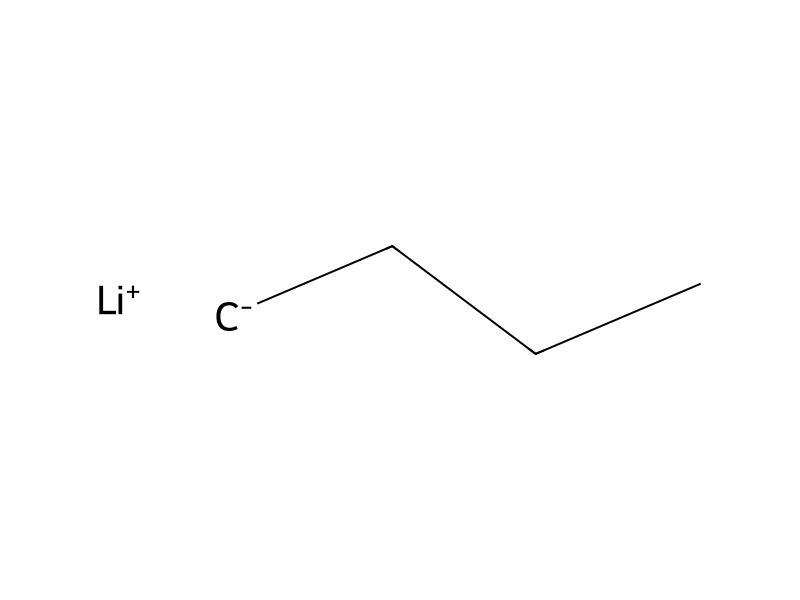
n-Butyl lithium → HCID 71254114, compound
Reaction equation

[Li+].CCC[CH2-].[F:6][C:7]([F:21])([F:20])[S:8]([NH:11][C:12]1[CH:17]=[CH:16][CH:15]=[C:14]([O:18][CH3:19])[CH:13]=1)(=[O:10])=[O:9].[Br:22][C:23]1[CH:24]=[CH:25][C:26]2[N:27]([CH2:37][CH:38]3[CH2:40][O:39]3)[C:28]3[C:33]([C:34]=2[CH:35]=1)=[CH:32][C:31]([Br:36])=[CH:30][CH:29]=3>O1CCOCC1.C(OCC)(=O)C.N.CO>[Br:22][C:23]1[CH:24]=[CH:25][C:26]2[N:27]([CH2:37][CH:38]([OH:39])[CH2:40][N:11]([C:12]3[CH:17]=[CH:16][CH:15]=[C:14]([O:18][CH3:19])[CH:13]=3)[S:8]([C:7]([F:20])([F:6])[F:21])(=[O:9])=[O:10])[C:28]3[C:33]([C:34]=2[CH:35]=1)=[CH:32][C:31]([Br:36])=[CH:30][CH:29]=3Participants
Reactant 3


Product 1

Reagents, catalysts & solvents 4




Conditions
- Temperature
- 90 °C
Procedure
N-butyllithium (2.5 M in hexanes, 48 ml) was added dropwise to an ice-cooled solution of 1,1,1-trifluoro-N-(3-methoxyphenyl)methanesulfonamide (22.07 g, 86.5 mmol) in dry dioxane (145 ml) over a 40 minute period. The solution was then stirred at rt for 15 minutes before addition of 3,6-dibromo-9-(oxiran-2-ylmethyl)-9H-carbazole (25.05 g, 65.7 mmol), followed by heating at 90° C. for an hour. These conditions were optimized to maximize conversion while minimizing formation of an aziridene by-product. The reaction was allowed to cool to rt then diluted with 1.2 L ethyl acetate and washed several times with water and finally brine. The organic layer was dried over MgSO4, filtered and condensed to give an orange viscous mixture. To this mixture was added 150 ml of 60% methylene chloride/hexanes, and the solution was then concentrated to generate a yellow foam (presumably this procedure helps remove residual ethyl acetate and/or dioxane). A further 150 ml of 60% methylene chloride/hexanes was added and stirred overnight. The mixture was filtered and washed several times with 60% methylene chloride/hexanes until the solid was white giving 20.1 g of 99% purity. A second crop gave 2.98 g in 91% purity. Filtrates and washings were combined and found to contain a 2:2.6:1 mixture of SM: product: aziridene by-product. This mixture was subjected to amination conditions by heating the mixture (24 g in approximately 2 equal portions) in ammonia in methanol (7N, 11 and 8 ml, respectively) at 100° C. in sealed pressure tubes overnight. Epoxide SM is converted to β-hydroxy amine (MacMillan et al., J. Am. Chem. Soc. 2011, 133, 1428), which aids chromatographic purification. Column chromatography in 80% DCM/hexanes gave a further 9.7 g of product with an overall yield of 32.78 g and 78%.
Workup
- temperatureto cool to rt
- washwashed several times with water and finally brine
- dry with materialThe organic layer was dried over MgSO4
- filtrationfiltered
- customcondensed
- customto give an orange viscous mixture
- concentrationthe solution was then concentrated
- customhelps remove residual ethyl acetate and/or dioxane)
- additionA further 150 ml of 60% methylene chloride/hexanes was added
- filtrationThe mixture was filtered
- washwashed several times with 60% methylene chloride/hexanes until the solid
- customwas white giving 20.1 g of 99% purity
- customA second crop gave 2.98 g in 91% purity
- additiona 2:2.6:1 mixture of SM
- customat 100° C.
- customin sealed pressure tubes overnight
- custompurification
Sources & evidence
- ORD record
- ord-5e7f41cc6cf94a7b81561225e6a97c0f
- Source dataset
- uspto-grants-2014_11
- Patent number
- US08877797B2
Reaction notes
Loading…