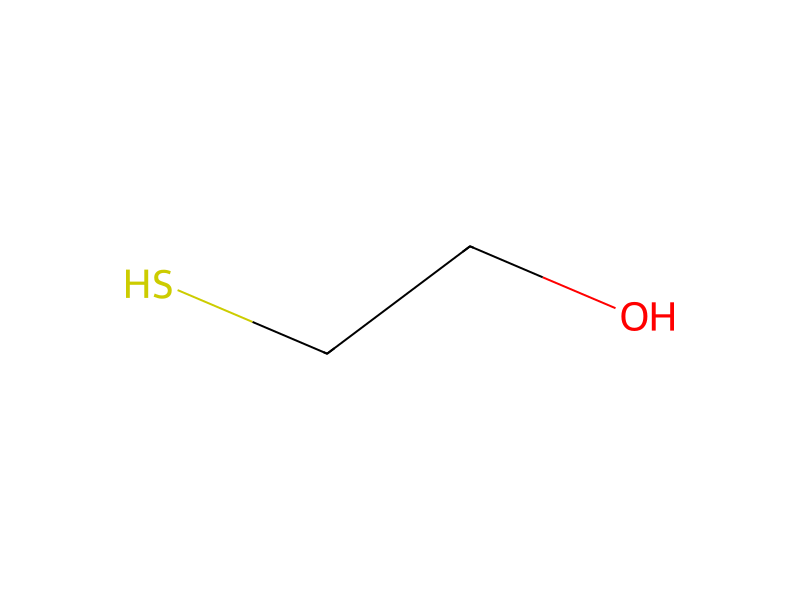
2-Mercaptoethanol → 4-(1,3-Dioxan-2-yl)-3-[(2-hydroxyethyl)sulfanyl]benzonitrile
Reaction equation

[O:1]1[CH2:6][CH2:5][CH2:4][O:3][CH:2]1[C:7]1[CH:14]=[CH:13][C:10]([C:11]#[N:12])=[CH:9][C:8]=1F.[SH:16][CH2:17][CH2:18][OH:19].C(=O)([O-])[O-].[K+].[K+]>CN(C=O)C>[O:1]1[CH2:6][CH2:5][CH2:4][O:3][CH:2]1[C:7]1[CH:14]=[CH:13][C:10]([C:11]#[N:12])=[CH:9][C:8]=1[S:16][CH2:17][CH2:18][OH:19]Participants
5




Procedure
The reaction was carried out under argon. 4-(1,3-Dioxan-2-yl)-3-fluorobenzonitrile (2.07 g, 10 mmol; 1.1 eq.) and 2-mercaptoethanol (0.71 g, 9.1 mmol; 1 eq.) were initially charged in DMF (50 ml). Potassium carbonate (3.14 g, 22.7 mmol; 2.5 eq.) was added at RT, and the mixture was stirred at boiling point for 1 h. TLC control then showed complete conversion. The mixture was concentrated and the residue was subjected to flash chromatography on silica gel (mobile phase: cyclohexane→cyclohexane/ethyl acetate 1:2). The title compound was obtained as a solid (2.33 g, 88% of theory).
Workup
- customfor 1 h
- concentrationThe mixture was concentrated
Sources & evidence
- ORD record
- ord-f36932982875463d923d7b5877126e00
- Source dataset
- uspto-grants-2014_11
- Patent number
- US08889700B2
Reaction notes
Loading…