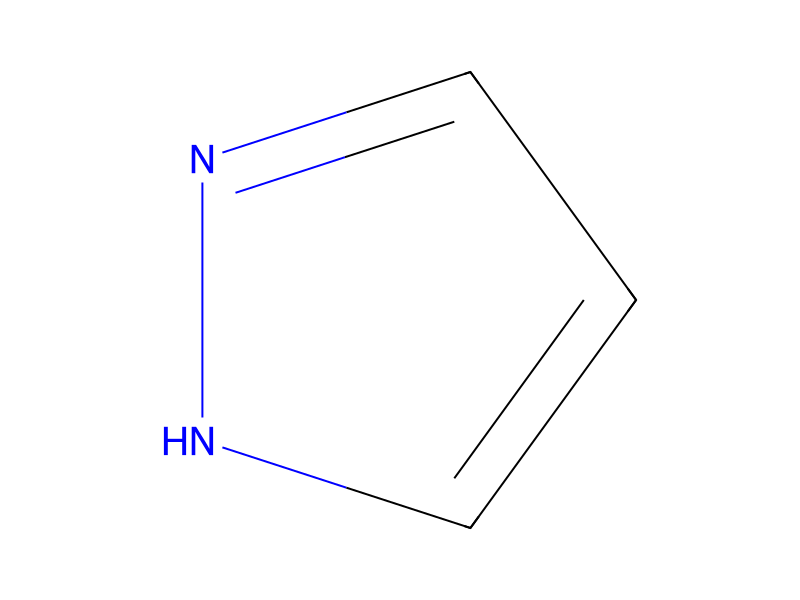
Pyrazole → 7-nitro-3-(1H-pyrazol-1-yl)quinoline
Reaction equation

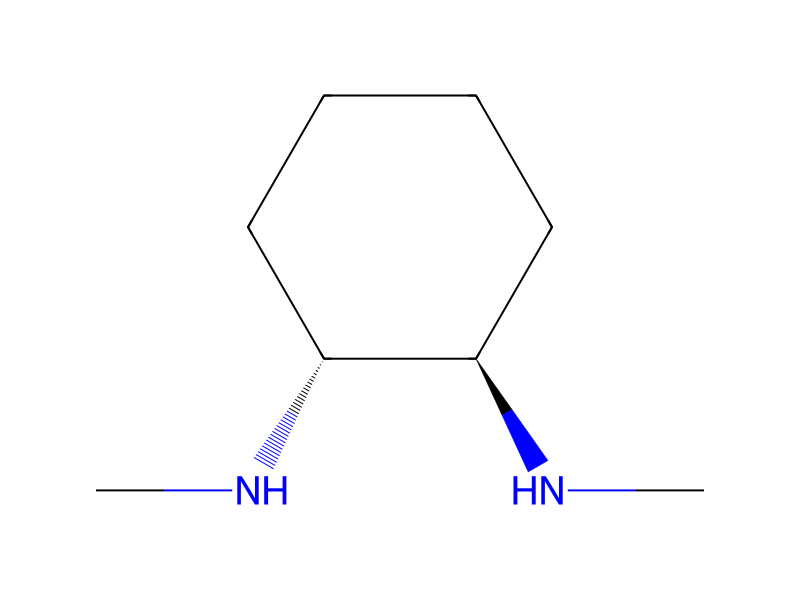
[NH:1]1[CH:5]=[CH:4][CH:3]=[N:2]1.CN[C@@H]1CCCC[C@H]1NC.C(=O)([O-])[O-].[Cs+].[Cs+].CC1N(C(N(C)C)=O)C1.I[C:32]1[CH:33]=[N:34][C:35]2[C:40]([CH:41]=1)=[CH:39][CH:38]=[C:37]([N+:42]([O-:44])=[O:43])[CH:36]=2>[Cu](I)I.O>[N+:42]([C:37]1[CH:36]=[C:35]2[C:40]([CH:41]=[C:32]([N:1]3[CH:5]=[CH:4][CH:3]=[N:2]3)[CH:33]=[N:34]2)=[CH:39][CH:38]=1)([O-:44])=[O:43]Participants
8
Reactant 5



Product 1

Reagents, catalysts & solvents 2


Conditions
- Temperature
- 70 °C
Procedure
Pyrazole (20 mg), trans-N,N′-dimethylcyclohexane-1,2-diamine (24 μl), copper iodide (14 mg), and cesium carbonate (73 mg) were added to an N,N-dimethylpropyleneurea (2 ml) solution containing 3-iodo-7-nitroquinoline (45 mg), followed by stirring at 70° C. for 2.5 hours in a nitrogen atmosphere. Water was added to the reaction solution, an insoluble precipitate was purified by silica gel chromatography (n-hexane:ethyl acetate=1:0 to 0:1), and a light yellow solid of 7-nitro-3-(1H-pyrazol-1-yl)quinoline (36 mg) was thus obtained.
Workup
- customan insoluble precipitate was purified by silica gel chromatography (n-hexane:ethyl acetate=1:0 to 0:1)
Sources & evidence
- ORD record
- ord-54b5fa05b94f4dc6b41458968b5a1eb6
- Source dataset
- uspto-grants-2014_11
- Patent number
- US08895585B2
Reaction notes
Loading…