Diisopropylethylamine → HCID 9977220, compound
Reaction equation

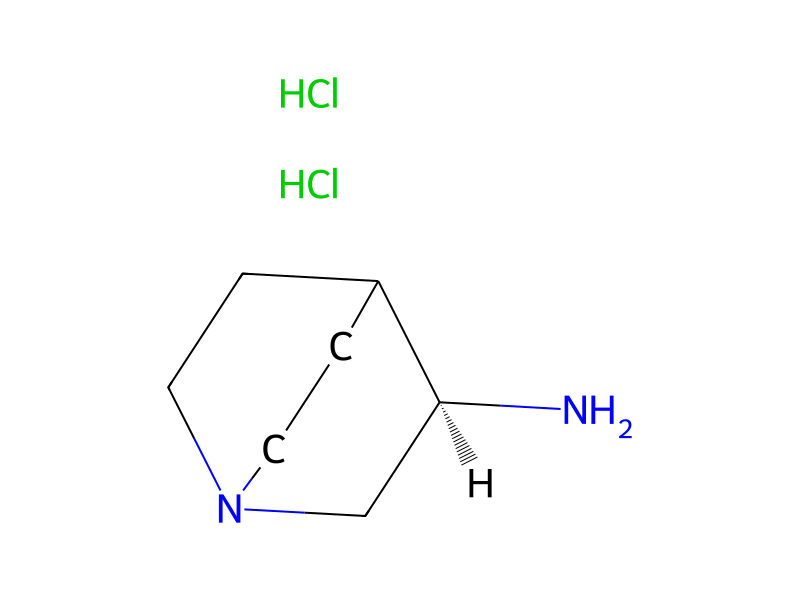
[I:1][C:2]1[CH:3]=[N:4][N:5]([C:7]([O:9]C2C=CC=CC=2)=O)[CH:6]=1.[ClH:16].Cl.[NH2:18][C@@H:19]1[CH:24]2[CH2:25][CH2:26][N:21]([CH2:22][CH2:23]2)[CH2:20]1.CCN(C(C)C)C(C)C>CN(C=O)C>[ClH:16].[N:21]12[CH2:26][CH2:25][CH:24]([CH2:23][CH2:22]1)[C@@H:19]([NH:18][C:7]([N:5]1[CH:6]=[C:2]([I:1])[CH:3]=[N:4]1)=[O:9])[CH2:20]2Participants
5
Reactant 3


Product 1

Reagents, catalysts & solvents 1

Procedure
Phenyl 4-iodo-1H-pyrazole-1-carboxylate (1.6 g, 5.2 mmol) and (R)-(+)-3-aminoquinuclidine dihydrochloride (1.0 g, 5.2 mmol) are suspended in 10 mL DMF. DIEA (2.7 mL, 15.5 mmol) is added dropwise. After 36 h, the solvent is removed and the residue is taken up in 1N NaOH and CHCl3. The aqueous layer is extracted with CHCl3, dried (MgSO4), filtered and concentrated. The residue is purified by chromatography (Biotage 40S, 90:9:1 CHCl3/MeOH/NH4OH) to provide 1.66 g (93%) of the product as a white solid. A portion of the material is converted into the hydrochloride salt and recrystallized from MeOH/EtOAc. HRMS (FAB) calcd for C11H15IN4O+H 347.0370, found 347.0357.
Workup
- customthe solvent is removed
- extractionThe aqueous layer is extracted with CHCl3
- dry with materialdried (MgSO4)
- filtrationfiltered
- concentrationconcentrated
- customThe residue is purified by chromatography (Biotage 40S, 90:9:1 CHCl3/MeOH/NH4OH)
Sources & evidence
- ORD record
- ord-1032ff07715e4c42a61964de3f6a0148
- Source dataset
- uspto-grants-2007_02
- Patent number
- US07176198B2
Reaction notes
Loading…