Potassium Carbonate → 3-chloro-2-(3-(trifluoromethyl)-1H-pyrazol-1-yl)pyridine
Reaction equation

Cl[C:2]1[C:7]([Cl:8])=[CH:6][CH:5]=[CH:4][N:3]=1.[F:9][C:10]([F:17])([F:16])[C:11]1[CH:15]=[CH:14][NH:13][N:12]=1.C(=O)([O-])[O-].[K+].[K+]>CN(C)C=O>[Cl:8][C:7]1[C:2]([N:13]2[CH:14]=[CH:15][C:11]([C:10]([F:17])([F:16])[F:9])=[N:12]2)=[N:3][CH:4]=[CH:5][CH:6]=1Participants
5


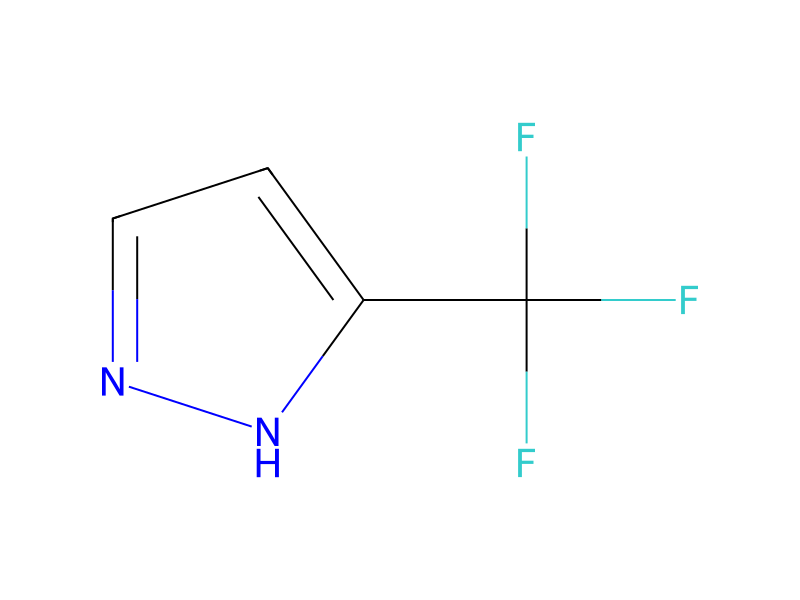


Conditions
- Temperature
- 100 °C
Procedure
To a mixture of 2,3-dichloropyridine (99.0 g, 0.67 mol) and 3-trifluoromethyl pyrazole (83 g, 0.61 mol) in dry N,N-dimethylformamide (300 mL) was added potassium carbonate (166.0 g, 1.2 mol) and the reaction was then heated to 110–125° C. over 48 hours. The reaction was cooled to 100° C. and filtered through Celite® diatomaceous filter aid to remove solids. N,N-Dimethylformamide and excess dichloropyridine were removed by distillation at atmospheric pressure. Distillation of the product at reduced pressure (b.p. 139–141° C., 7 mm) afforded the desired intermediate as a clear yellow oil (113.4 g).
Workup
- temperaturethe reaction was then heated to 110–125° C. over 48 hours
- filtrationfiltered through Celite® diatomaceous filter aid
- customto remove solids
- customN,N-Dimethylformamide and excess dichloropyridine were removed by distillation at atmospheric pressure
- distillationDistillation of the product at reduced pressure (b.p. 139–141° C., 7 mm)
Sources & evidence
- ORD record
- ord-4151327a853d436b9583dbc6aa7d254d
- Source dataset
- uspto-grants-2007_02
- Patent number
- US07179824B2
Reaction notes
Loading…