4-Penten-2-OL → 4E-N-methyl-5-(5-methoxy-3-pyridyl)-4-penten-2ol
Reaction equation

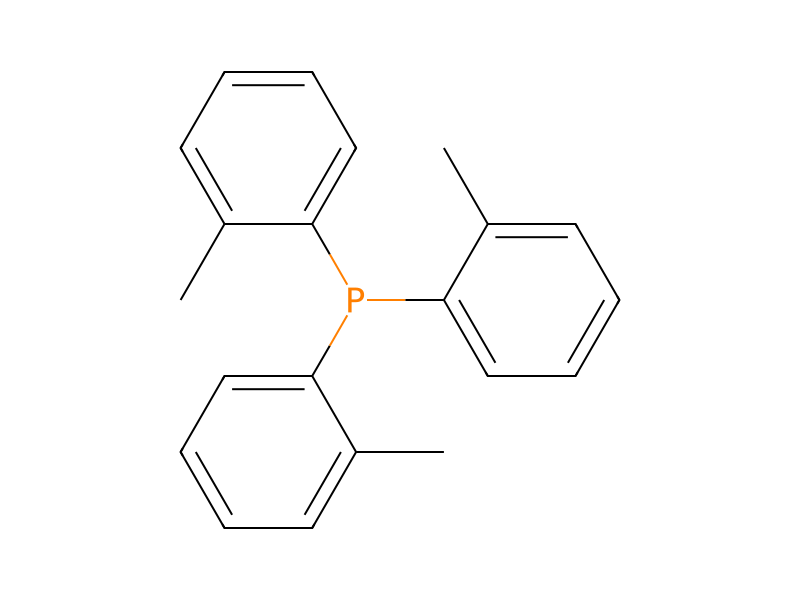
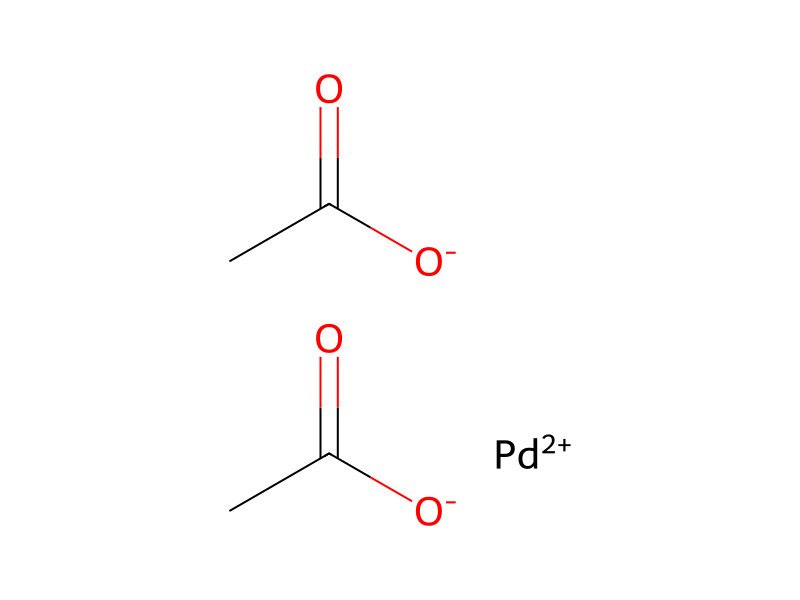
Br[C:2]1[CH:3]=[C:4]([O:8][CH3:9])[CH:5]=[N:6][CH:7]=1.[CH3:10][CH:11]([OH:15])[CH2:12][CH:13]=[CH2:14].[C:16]1(C)C=CC=CC=1P(C1C=CC=CC=1C)C1C=CC=CC=1C>C(#N)C.C(N(CC)CC)C.C([O-])(=O)C.[Pd+2].C([O-])(=O)C>[CH3:16][N:6]1[CH:5]=[C:4]([O:8][CH3:9])[CH:3]=[C:2](/[CH:14]=[CH:13]/[CH2:12][CH:11]([OH:15])[CH3:10])[CH2:7]1Participants




Conditions
- Temperature
- 140 °C
Procedure
The manner in which certain aryl substituted olefinic amine compounds possessing a branched side chain are provided can vary. Using one synthetic approach, a compound such as (4E)-N-methyl-5-(5-methoxy-3-pyridyl)-4-penten-2-amine can be synthesized by coupling a halo-substituted pyridine, 5-bromo-3-methoxypyridine with an olefin containing a secondary alcohol functionality, 4-penten-2-ol, under Heck reaction conditions; and the resulting pyridyl alcohol intermediate can be converted to its p-toluenesulfonate ester, followed by treatment with methylamine. Typically, the types of procedures set forth in W. C. Frank et al., J. Org. Chem. 43: 2947 (1978) and N. J. Malek et al., J. Org. Chem. 47: 5395 (1982) involving a palladium-catalyzed coupling of an olefin and an aromatic halide are used. The required halo-substituted pyridine, 5-bromo-3-methoxypyridine is synthesized using methodology similar to that described by H. J. den Hertog et al., Recl. Trav. Chim. Pays-Bas 67:377 (1948), namely by heating 3,5-dibromopyridine with 2.5 molar equivalents of sodium methoxide in dry methanol in the presence of copper powder (5%, w/w of the 3,5-dibromopyridine) in a sealed glass tube at 150° C. for 14 hours to produce 5-bromo-3-methoxypyridine. The resulting 5-bromo-3-methoxypyridine, previously described by D. L. Comins, et al., J. Org. Chem. 55: 69 (1990), can be coupled with 4-penten-2-ol in acetonitrile-triethylamine (1:1:1, v/v) using a catalyst consisting of 1 mole % palladium(II) acetate and 4 mole % tri-o-tolylphosphine. The reaction is carried out by heating the components in a sealed glass tube at 140° C. for 14 hours to yield (4E)-N-methyl-5-(5-methoxy-3-pyridyl)-4-penten-2-ol. The resulting alcohol is treated with 2 molar equivalents of p-toluenesulfonyl chloride in dry pyridine at 0° C. to produce (4E)-N-methyl-5-(5-methoxy-3-pyridyl)-4-penten-2-ol p-toluensulfonate. The tosylate intermediate is treated with 120-molar equivalents of methylamine as a 40% aqueous solution, containing a small amount of ethanol as a co-solvent to produce (4E)-N-methyl-5-(5-methoxy-3-pyridyl)-4-penten-2-amine. When 3,5-dibromopyridine is submitted to Heck coupling with N-methyl-N-(tert-butoxycarbonyl)-4-penten-2-amine, under conditions described above, N-methyl-N-(tert-butoxycarbonyl)-5-(5-bromo-3-pyridyl)-4-penten-2-amine is produced. This can be coupled in a subsequent Heck reaction with styrene and deprotected (removal of the tert-butoxycarbonyl group), as described previously, to give (4E)-N-methyl-5-[3-(5-trans-beta-styrylpyridin)yl]-4-penten-2-amine. Similar second coupling with ethynylbenzene, and subsequent deprotection, will give (4E)-N-methyl-5-[3-(5-phenylethynylpyridin)yl]-4-penten-2-amine.
Sources & evidence
- ORD record
- ord-d668e95e3d084b79967dc056faddff5e
- Source dataset
- uspto-grants-2004_06
- Patent number
- US06743812B1
Reaction notes
Loading…