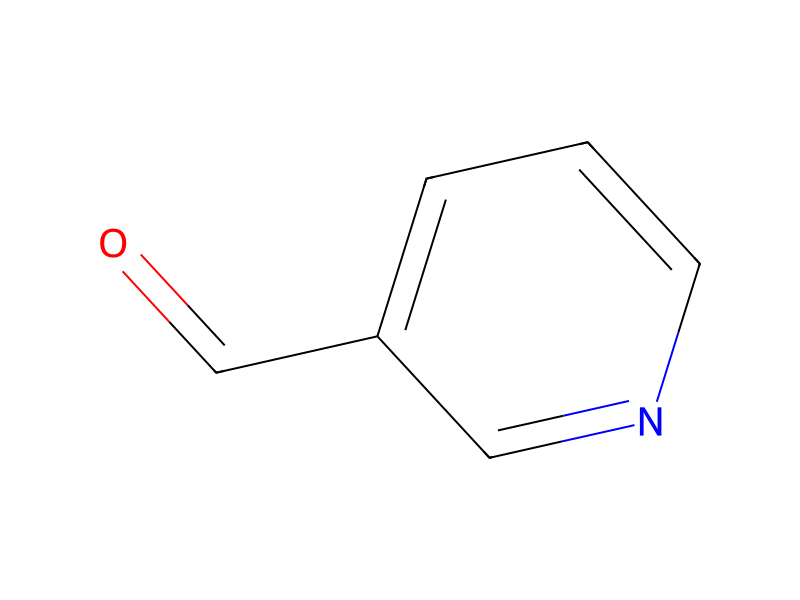
3-Pyridinecarboxaldehyde → 2-[(3-Pyridyl)hydroxymethyl]-6-(2-methyl-1,3-dioxolan-2-yl)naphthalene
Reaction equation

Br[C:2]1[CH:11]=[CH:10][C:9]2[C:4](=[CH:5][CH:6]=[C:7]([C:12]3([CH3:17])[O:16][CH2:15][CH2:14][O:13]3)[CH:8]=2)[CH:3]=1.C([Li])(C)(C)C.[N:23]1[CH:28]=[CH:27][CH:26]=[C:25]([CH:29]=[O:30])[CH:24]=1>O1CCCC1>[N:23]1[CH:28]=[CH:27][CH:26]=[C:25]([CH:29]([OH:30])[C:2]2[CH:11]=[CH:10][C:9]3[C:4](=[CH:5][CH:6]=[C:7]([C:12]4([CH3:17])[O:16][CH2:15][CH2:14][O:13]4)[CH:8]=3)[CH:3]=2)[CH:24]=1Participants
Reactant 3


Product 1

Reagents, catalysts & solvents 1

Procedure
A solution of 4.5 g of 2-bromo-6-(2-methyl-1,3-dioxolan-2-yl)naphthalene in 30 ml of tetrahydrofuran was cooled to -78° C. under nitrogen, and 14.0 ml of 2.2M t-butyl lithium added dropwise. A solution of 1.64 g of 3-pyridinecarboxaldehyde in 15 ml of tetrahydrofuran was added over a period of 10 minutes, and the temperature was allowed to rise to -20° C. during the next 30 minutes. The reaction was quenched with 30 ml of water and the mixture extracted with methylene chloride. The organic layer was dried over sodium sulfate and solvent removed under reduced pressure to give a solid that was recrystallized from methylene chloride/diethyl ether to give 3.1 g of 2-[(3-pyridyl)hydroxymethyl]-6-(2-methyl-1,3-dioxolan-2-yl)naphthalene, m.p. 154°-156° C.
Workup
- customto rise to -20° C. during the next 30 minutes
- customThe reaction was quenched with 30 ml of water
- extractionthe mixture extracted with methylene chloride
- dry with materialThe organic layer was dried over sodium sulfate and solvent
- customremoved under reduced pressure
- customto give a solid
- customthat was recrystallized from methylene chloride/diethyl ether
Sources & evidence
- ORD record
- ord-91ab7496c7d048febe8a88218f6c8816
- Source dataset
- uspto-grants-1988_08
- Patent number
- US04766127
Reaction notes
Loading…