Indole → 5-Chloroindoline
Reaction equation

N1C2C(=CC=CC=2)C=C1.[Cl:10][C:11]1[CH:12]=[C:13]2[C:17](=[CH:18][CH:19]=1)[NH:16][CH:15]=[CH:14]2>>[Cl:10][C:11]1[CH:12]=[C:13]2[C:17](=[CH:18][CH:19]=1)[NH:16][CH2:15][CH2:14]2Participants
Reactant 2
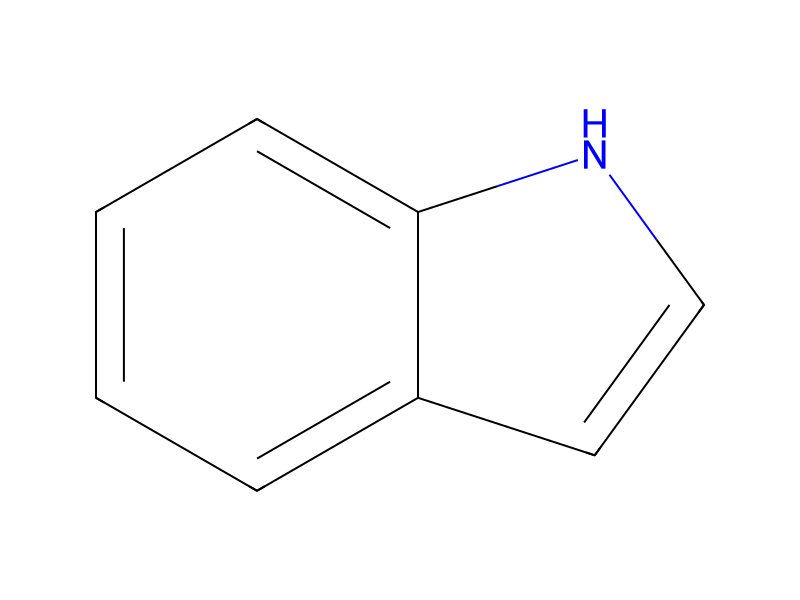

Product 1

Procedure
In another comparison example in which 5% ruthenium-carbon catalyst without a nitrocompound as the hydrogen acceptor was used, a mixture of 307.2 g (2 moles) of 5-chloro-indoline, 500 ml of xylene and 15 g of 5% ruthenium-carbon catalyst was refluxed with stirring for 7 hours and the mixture was then cooled and vacuum filtered. 800 ml of dilute hydrochloric acid formed from 130 ml of concentrated hydrochloric acid and 670 ml of water was added in 3 equal portions to the filtrate. The organic phase was dried over potassium carbonate and was evaporated to dryness under reduced pressure. The residue was subjected to fractional distillation to obtain a first fraction of 146 g of a product with a boiling point of 92° to 98° C. at 0.03 mbar and a melting point of 57° to 60° C. and a residue of 12 g (4% yield). Gas chromatography of the first fraction indicated that it was a mixture of 35% of indole and 65% of 5-chloro-indole. The acid extract was neutralized to recover 132 g (42.8% yield) of 5-chloro-indoline.
Workup
- extractionThe acid extract
Sources & evidence
- ORD record
- ord-00e15c5b781f4ea49d5cc8fe83a3fd72
- Source dataset
- uspto-grants-1983_03
- Patent number
- US04377699
Reaction notes
Loading…