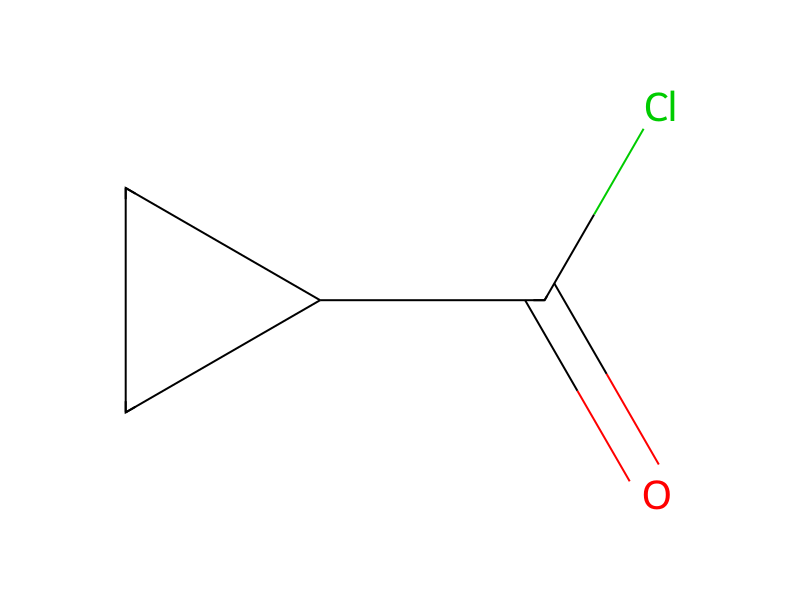
Cyclopropanecarbonyl chloride → N-(3-{3-methyl-[1,2,4]triazolo[4,3-b]pyridazin-6-yl}phenyl)cyclopropanecarboxamide
Reaction equation

[CH3:1][C:2]1[N:6]2[N:7]=[C:8]([C:11]3[CH:16]=[CH:15][CH:14]=[C:13]([NH2:17])[CH:12]=3)[CH:9]=[CH:10][C:5]2=[N:4][N:3]=1.C(N(CC)C(C)C)(C)C.[CH:27]1([C:30](Cl)=[O:31])[CH2:29][CH2:28]1>ClCCl>[CH3:1][C:2]1[N:6]2[N:7]=[C:8]([C:11]3[CH:12]=[C:13]([NH:17][C:30]([CH:27]4[CH2:29][CH2:28]4)=[O:31])[CH:14]=[CH:15][CH:16]=3)[CH:9]=[CH:10][C:5]2=[N:4][N:3]=1Participants
5
Reactant 3


Product 1

Reagents, catalysts & solvents 1

Procedure
To a solution of 7.6 g of 3-methyl-6-(3-aminophenyl)-1,2,4-triazolo[4,3-b]-pyridazine in 1.5 liters of dichloromethane was added 6 ml of N,N-diisopropylethylamine and 3.1 ml of cyclopropane carboxylic acid chloride. The solution was stirred at room temperature for 4 hours, washed with 200 ml of saturated sodium bicarbonate solution, dried and the solvent removed in vacuo. The residue was crystallized from dichloromethanehexane to give 2.24 g of tan crystals, mp 255°-258° C. A sample recrystallized from dichloromethane-hexane gave white crystals, mp 259°-262° C.
Workup
- washwashed with 200 ml of saturated sodium bicarbonate solution
- customdried
- customthe solvent removed in vacuo
- customThe residue was crystallized from dichloromethanehexane
Sources & evidence
- ORD record
- ord-f84d5a49f64d4285af1b28b0cd4f6fac
- Source dataset
- uspto-grants-1988_08
- Patent number
- US04767765
Reaction notes
Loading…