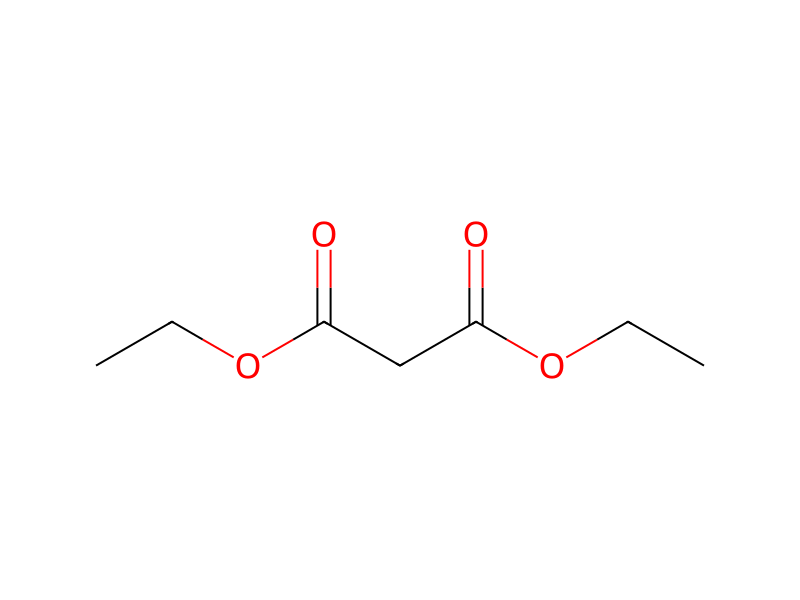
Diethyl Malonate → 3-Hydroxy-5-mesitylcyclohex-2-en-1-one
Reaction equation

C(OCC)(=O)[CH2:2][C:3](OCC)=[O:4].[Na].[CH3:13][C:14]1[CH:19]=[C:18]([CH3:20])[CH:17]=[C:16]([CH3:21])[C:15]=1[CH:22]=[CH:23][C:24](=[O:26])[CH3:25].[OH-].[Na+]>C(O)C.O>[OH:26][C:24]1[CH2:23][CH:22]([C:15]2[C:16]([CH3:21])=[CH:17][C:18]([CH3:20])=[CH:19][C:14]=2[CH3:13])[CH2:2][C:3](=[O:4])[CH:25]=1Participants






Procedure
Diethyl malonate (10.1 g; 60 mmole) was added to a solution of sodium metal (1.4 g; 60 mmole) in anhydrous absolute ethanol (50 ml) and the mixture was heated to reflux temperature. A mixture of 1-(2,4,6-trimethylphenyl)but-1-en-3-one (11.4 g; 61 mmole) in anhydrous absolute ethanol (50 ml) was added over a period of 2 minutes and the mixture was heated under reflux for a period of 2 hours. An aqueous solution of sodium hydroxide (7.3 g; 180 mmole in 100 ml of water) was added and the mixture was heated under reflux for a further 41/2 hours. The solution was poured into water (200 ml) and the aqueous mixture was extracted twice with ethyl acetate (100 ml). The aqueous phase was acidified with concentrated hydrochloric acid and warmed gently until the evolution of carbon dioxide ceased. The aqueous mixture was extracted with ethyl acetate, dried over anhydrous sodium sulfate, and the solvent was removed by evaporation under reduced pressure using a rotary evaporator. The product, 3-hydroxy-5-mesitylcyclohex-2-en-1-one, was obtained as a pale yellow solid (10.9 g; 77.4%), mp 165° C. Proton magnetic resonance spectrum (dimethylsulfoxide; δ in ppm): 2.0-4.1 (14H, m); 5.2 (1H, s); 6.8 (2H, s); 11.2 (1H, br.s).
Workup
- temperaturethe mixture was heated
- temperatureto reflux temperature
- additionwas added over a period of 2 minutes
- temperaturethe mixture was heated
- temperatureunder reflux for a period of 2 hours
- temperaturethe mixture was heated
- temperatureunder reflux for a further 41/2 hours
- extractionthe aqueous mixture was extracted twice with ethyl acetate (100 ml)
- temperaturewarmed gently until the evolution of carbon dioxide
- extractionThe aqueous mixture was extracted with ethyl acetate
- dry with materialdried over anhydrous sodium sulfate
- customthe solvent was removed by evaporation under reduced pressure
- customa rotary evaporator
Sources & evidence
- ORD record
- ord-7e4825c453c444408c20b24f6f701213
- Source dataset
- uspto-grants-1988_08
- Patent number
- US04767879
Reaction notes
Loading…