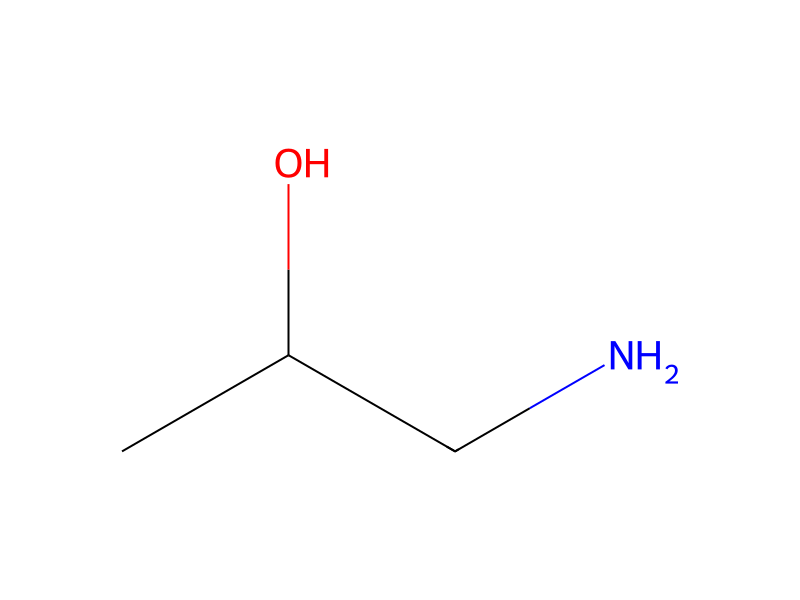
1-Amino-2-propanol → 2-[(1,1-dimethylethyl)amino]-N-(2-hydroxypropyl)-4-(trifluoromethyl)-5-oxazolecarboxamide
Reaction equation

[NH2:1][CH2:2][CH:3]([OH:5])[CH3:4].C(N(CC)CC)C.[C:13]([NH:17][C:18]1[O:19][C:20]([C:27](Cl)=[O:28])=[C:21]([C:23]([F:26])([F:25])[F:24])[N:22]=1)([CH3:16])([CH3:15])[CH3:14]>C(Cl)Cl>[CH3:14][C:13]([NH:17][C:18]1[O:19][C:20]([C:27]([NH:1][CH2:2][CH:3]([OH:5])[CH3:4])=[O:28])=[C:21]([C:23]([F:26])([F:25])[F:24])[N:22]=1)([CH3:16])[CH3:15]Participants
5




Procedure
By the procedure of Example 38, a stirred mixture of 70 ml methylene chloride, 1.80 g (24 mmol) of 1-amino-2-propanol, 2.68 g (13.2 mmol) of triethylamine, and 6.50 g (24 mmol) of 2-(tert-butylamino)-4-trifluoromethyl-5-oxazolecarbonyl chloride was reacted for 16 hours at ambient temperature. The product was separated and then recrystallized to yield 3.42 g of a white solid product (m.p.=105°-107° C.) identified in Table I.
Workup
- customwas reacted for 16 hours at ambient temperature
- customThe product was separated
- customrecrystallized
Sources & evidence
- ORD record
- ord-1fe539d315c34e869752ef0adec1001f
- Source dataset
- uspto-grants-1991_03
- Patent number
- US05000775
Reaction notes
Loading…