3-Bromo-1-propanol → 4-Benzhydryl-1-piperazinepropanol
Reaction equation

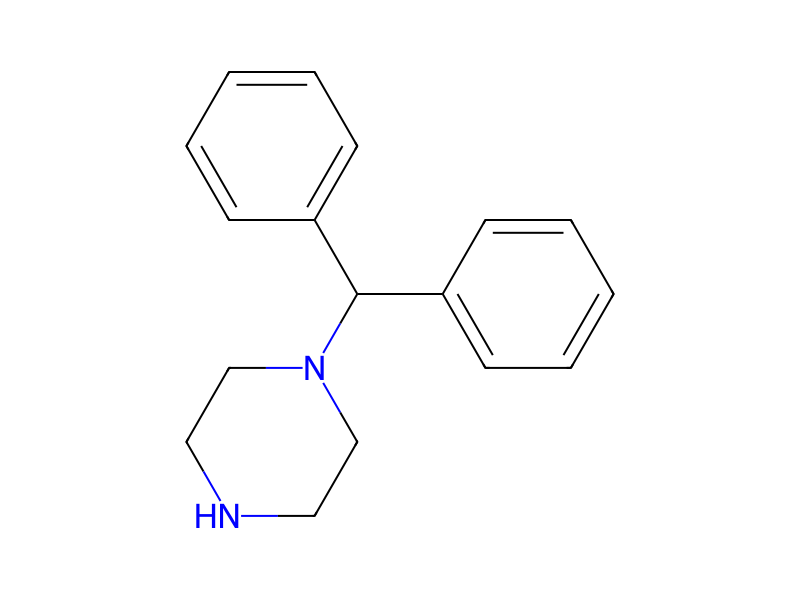
[CH:1]([N:14]1[CH2:19][CH2:18][NH:17][CH2:16][CH2:15]1)([C:8]1[CH:13]=[CH:12][CH:11]=[CH:10][CH:9]=1)[C:2]1[CH:7]=[CH:6][CH:5]=[CH:4][CH:3]=1.C(N(C(C)C)CC)(C)C.Br[CH2:30][CH2:31][CH2:32][OH:33]>O1CCOCC1.O>[CH:1]([N:14]1[CH2:19][CH2:18][N:17]([CH2:30][CH2:31][CH2:32][OH:33])[CH2:16][CH2:15]1)([C:8]1[CH:13]=[CH:12][CH:11]=[CH:10][CH:9]=1)[C:2]1[CH:7]=[CH:6][CH:5]=[CH:4][CH:3]=1Participants
5
Reactant 3


Product 1

Reagents, catalysts & solvents 1

Procedure
To 1-benzhydrylpiperazine (64 mmol) and diisopropylethylamine (77 mmol) in dioxane/H2O (9:1, 100 mL) is added 3-bromo-1-propanol (64 mmol) while stirring. After about 17 hours, the solution is concentrated in vacuo, and the residue is taken up in EtOAc (250 mL) and washed with 1N NaOH (2×100 mL), and brine (2×). The organic phase is dried over Na2SO4 (s), concentrated in vacuo and recrystallized from hot EtOAc to afford white crystalline product.
Workup
- concentrationthe solution is concentrated in vacuo
- washwashed with 1N NaOH (2×100 mL), and brine (2×)
- dry with materialThe organic phase is dried over Na2SO4 (s)
- concentrationconcentrated in vacuo
- customrecrystallized from hot EtOAc
- customto afford white crystalline product
Sources & evidence
- ORD record
- ord-b0a72097869f4f86abbce74ae5ed7951
- Source dataset
- uspto-grants-2000_10
- Patent number
- US06130217
Reaction notes
Loading…