Triphenylphosphine → 3-(3-Bromopropoxy)benzonitrile
Reaction equation

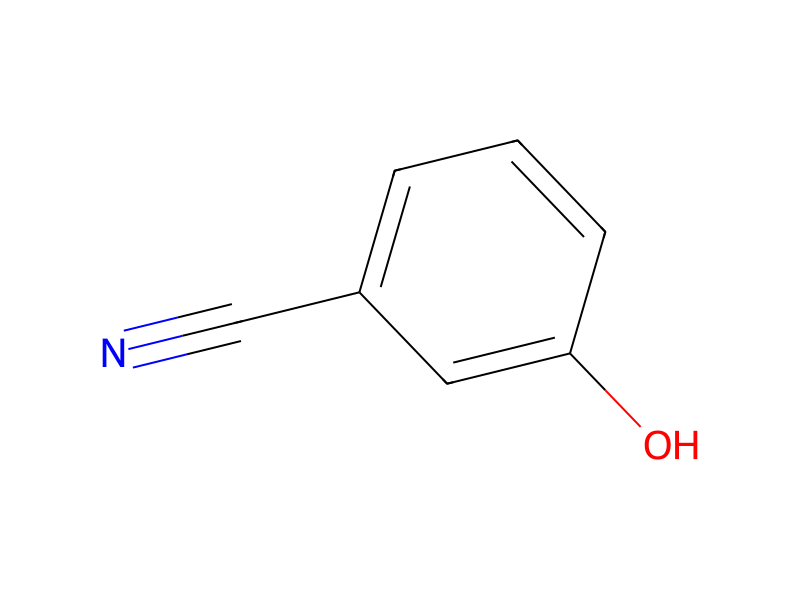
[C:1]([C:3]1[CH:4]=[C:5]([OH:9])[CH:6]=[CH:7][CH:8]=1)#[N:2].[Br:10][CH2:11][CH2:12][CH2:13]O.C1(P(C2C=CC=CC=2)C2C=CC=CC=2)C=CC=CC=1.CCOC(/N=N/C(OCC)=O)=O>C1COCC1.CCOCC>[Br:10][CH2:11][CH2:12][CH2:13][O:9][C:5]1[CH:4]=[C:3]([CH:8]=[CH:7][CH:6]=1)[C:1]#[N:2]Participants
7






Procedure
3-Cyanophenol (10.0 g, 84 mM), 3-bromopropanol (20.3 mL, 114 mM), triphenylphosphine (29.7 g, 114 mM) were stirred in anhydrous THF (40 mL) at room temperature and treated with diethylazodicarboxylate (17.8 mL, 114 mM) dropwise over 5 min. under an atmosphere of nitrogen. This mixture stirred for about 5 hours then diluted with ether (500 mL) and filtered through Celite™. The filtrate was concentrated to a reddish oil which was again dissolved in ether (250 mL), diluted with hexanes (200 mL) and filtered. The filtrates were concentrated then filtered through a silica pad (300 g) eluting with 35% acetone/hexanes to collect the desired product as a yellow oil, 16.85 g. This material was used in its crude form.
Workup
- filtrationfiltered through Celite™
- concentrationThe filtrate was concentrated to a reddish oil which
- dissolutionwas again dissolved in ether (250 mL)
- additiondiluted with hexanes (200 mL)
- filtrationfiltered
- concentrationThe filtrates were concentrated
- filtrationthen filtered through a silica pad (300 g)
- washeluting with 35% acetone/hexanes
- customto collect the desired product as a yellow oil, 16.85 g
Sources & evidence
- ORD record
- ord-7b16a01611e84f738fc7e17009ef6e43
- Source dataset
- uspto-grants-2000_10
- Patent number
- US06130217
Reaction notes
Loading…