Ammonium Hydroxide → 4-[5-benzoyl-1,4-dimethyl-1H-pyrrol-2-ylmethyl]aniline
Reaction equation
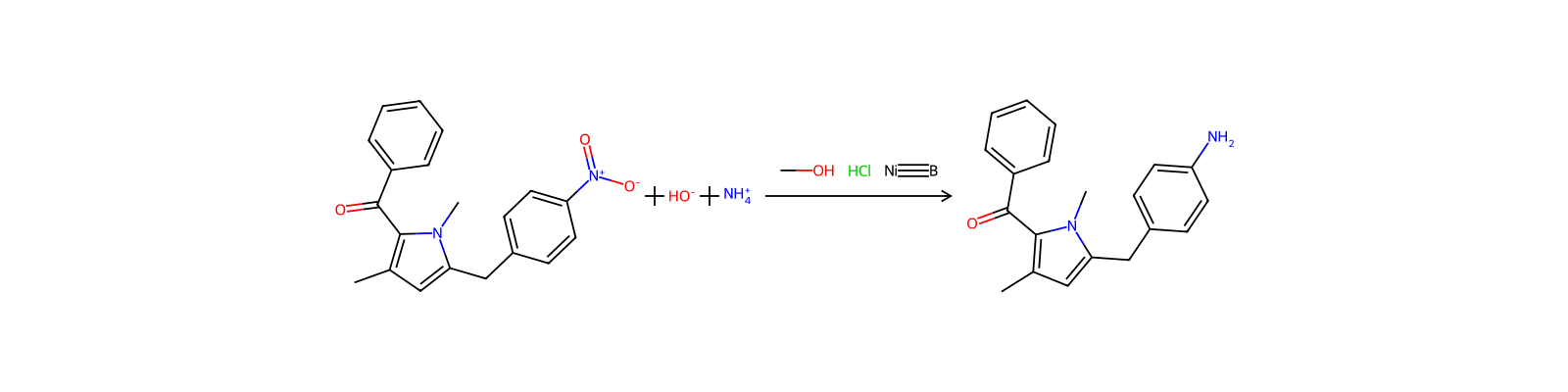
[C:1]([C:9]1[N:13]([CH3:14])[C:12]([CH2:15][C:16]2[CH:21]=[CH:20][C:19]([N+:22]([O-])=O)=[CH:18][CH:17]=2)=[CH:11][C:10]=1[CH3:25])(=[O:8])[C:2]1[CH:7]=[CH:6][CH:5]=[CH:4][CH:3]=1.[OH-].[NH4+]>CO.Cl.B#[Ni]>[C:1]([C:9]1[N:13]([CH3:14])[C:12]([CH2:15][C:16]2[CH:17]=[CH:18][C:19]([NH2:22])=[CH:20][CH:21]=2)=[CH:11][C:10]=1[CH3:25])(=[O:8])[C:2]1[CH:3]=[CH:4][CH:5]=[CH:6][CH:7]=1Participants
6
Reactant 2


Product 1

Reagents, catalysts & solvents 3



Conditions
- Temperature
- 75 °C
Procedure
To a slurry of 4-[5-benzoyl-1,4-dimethyl-1H-pyrrol-2-ylmethyl]nitrobenzene (3.55 g, 10.6 mmol) [prepared as in Example 2, Step (a)] in methanol (170 ml) and hydrochloric acid (50 ml, 1M) was added nickel boride (3.41 g, 26.6 mmol), and the mixture was stirred at 75° C. for 15 h. The reaction mixture was cooled, basified with ammonium hydroxide and the product was extracted into ethyl acetate. The organic phase was washed with water and dried over sodium sulfate. Evaporation of the solvent gave 4-[5-benzoyl-1,4-dimethyl-1H-pyrrol-2-ylmethyl]aniline (3.11 g, 96%) as a pale yellow solid.
Workup
- temperatureThe reaction mixture was cooled
- extractionthe product was extracted into ethyl acetate
- washThe organic phase was washed with water
- dry with materialdried over sodium sulfate
- customEvaporation of the solvent
Sources & evidence
- ORD record
- ord-1bef74759a994ed8b85dfc7f695aff63
- Source dataset
- uspto-grants-2000_10
- Patent number
- US06136844
Reaction notes
Loading…