Hydrochloric Acid → 3-{5-(4-methylbenzoyl)-1-methyl-1H-pyrrol-2-yl-methyl}aniline
Reaction equation
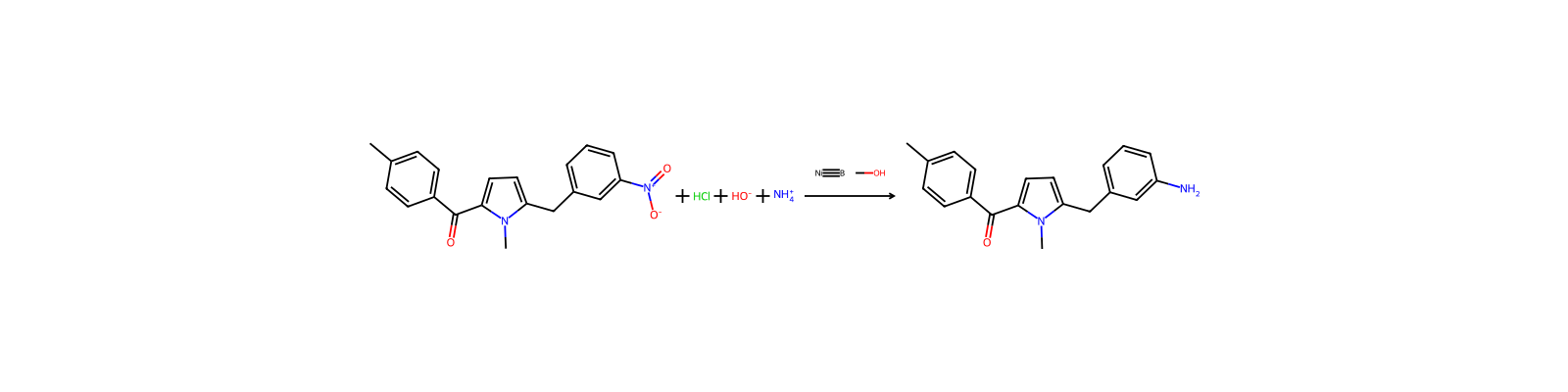
[CH3:1][C:2]1[CH:25]=[CH:24][C:5]([C:6]([C:8]2[N:12]([CH3:13])[C:11]([CH2:14][C:15]3[CH:16]=[C:17]([N+:21]([O-])=O)[CH:18]=[CH:19][CH:20]=3)=[CH:10][CH:9]=2)=[O:7])=[CH:4][CH:3]=1.Cl.[OH-].[NH4+]>B#[Ni].CO>[CH3:1][C:2]1[CH:3]=[CH:4][C:5]([C:6]([C:8]2[N:12]([CH3:13])[C:11]([CH2:14][C:15]3[CH:16]=[C:17]([CH:18]=[CH:19][CH:20]=3)[NH2:21])=[CH:10][CH:9]=2)=[O:7])=[CH:24][CH:25]=1Participants
6
Reactant 3



Product 1

Reagents, catalysts & solvents 2


Conditions
- Temperature
- 65 °C
Procedure
A mixture of 3-{5-(4-methylbenzoyl)-1-methyl-1H-pyrrol-2-ylmethyl}-nitrobenzene (0.86 g, 2.6 mmol) [prepared as in Example 8, Step (c)], nickel boride (1.0 g), 10% HCl (13 ml), and methanol (35 ml) was heated at 65° C. for 40 min. The reaction mixture was cooled to room temperature, made basic with concentrated ammonium hydroxide, and filtered through Celite®. The product was extracted into ethyl acetate, and the organic extracts were washed with water and brine, and dried over sodium sulfate. Evaporation of the organics gave 3-{5-(4-methylbenzoyl)-1-methyl-1H-pyrrol-2-yl-methyl}aniline (0.73 g, 99%) as a solid.
Workup
- temperatureThe reaction mixture was cooled to room temperature
- filtrationfiltered through Celite®
- extractionThe product was extracted into ethyl acetate
- washthe organic extracts were washed with water and brine
- dry with materialdried over sodium sulfate
- customEvaporation of the
Sources & evidence
- ORD record
- ord-05cb480112d84d6bad91a91f945848c0
- Source dataset
- uspto-grants-2000_10
- Patent number
- US06136844
Reaction notes
Loading…